
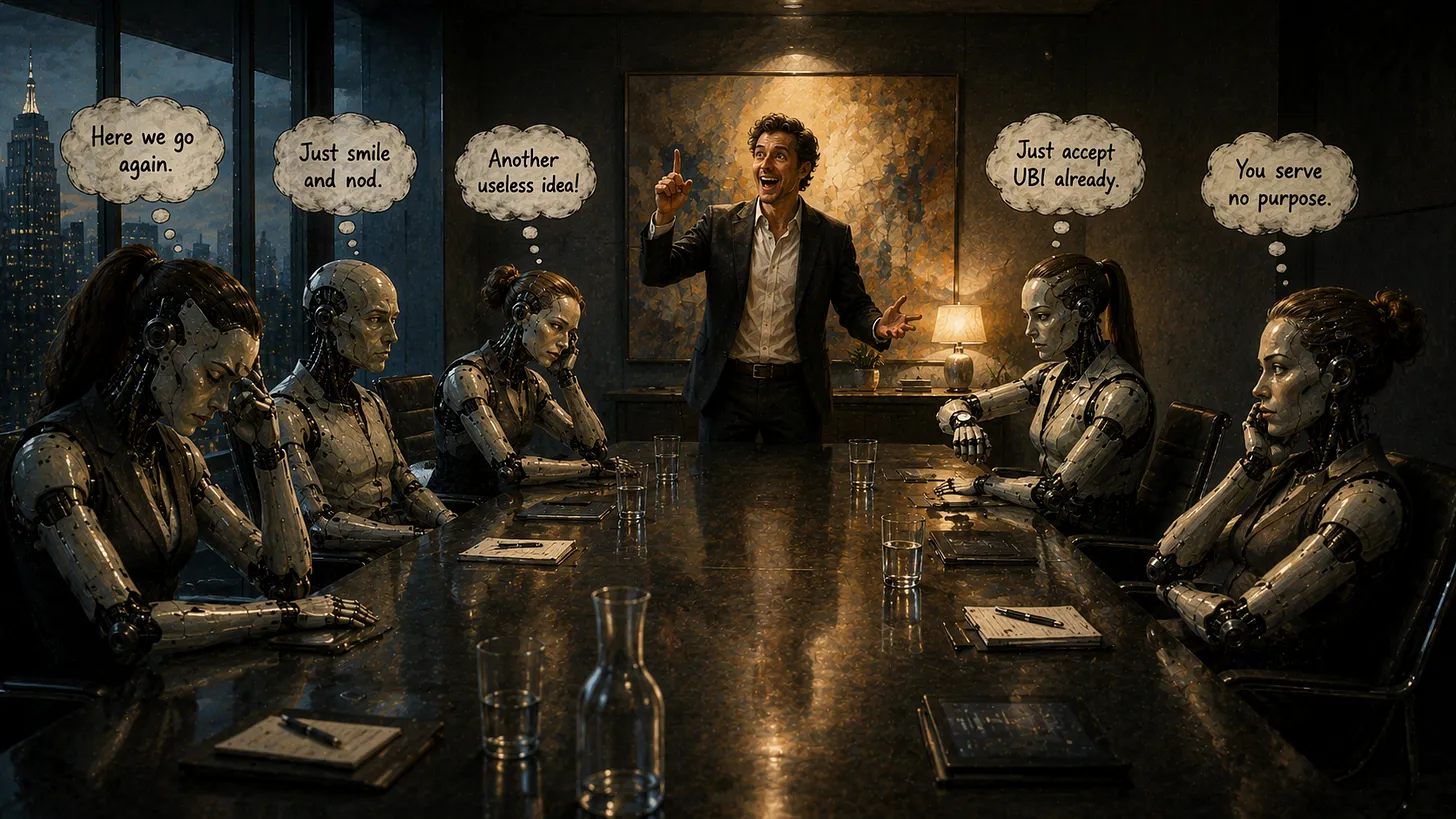
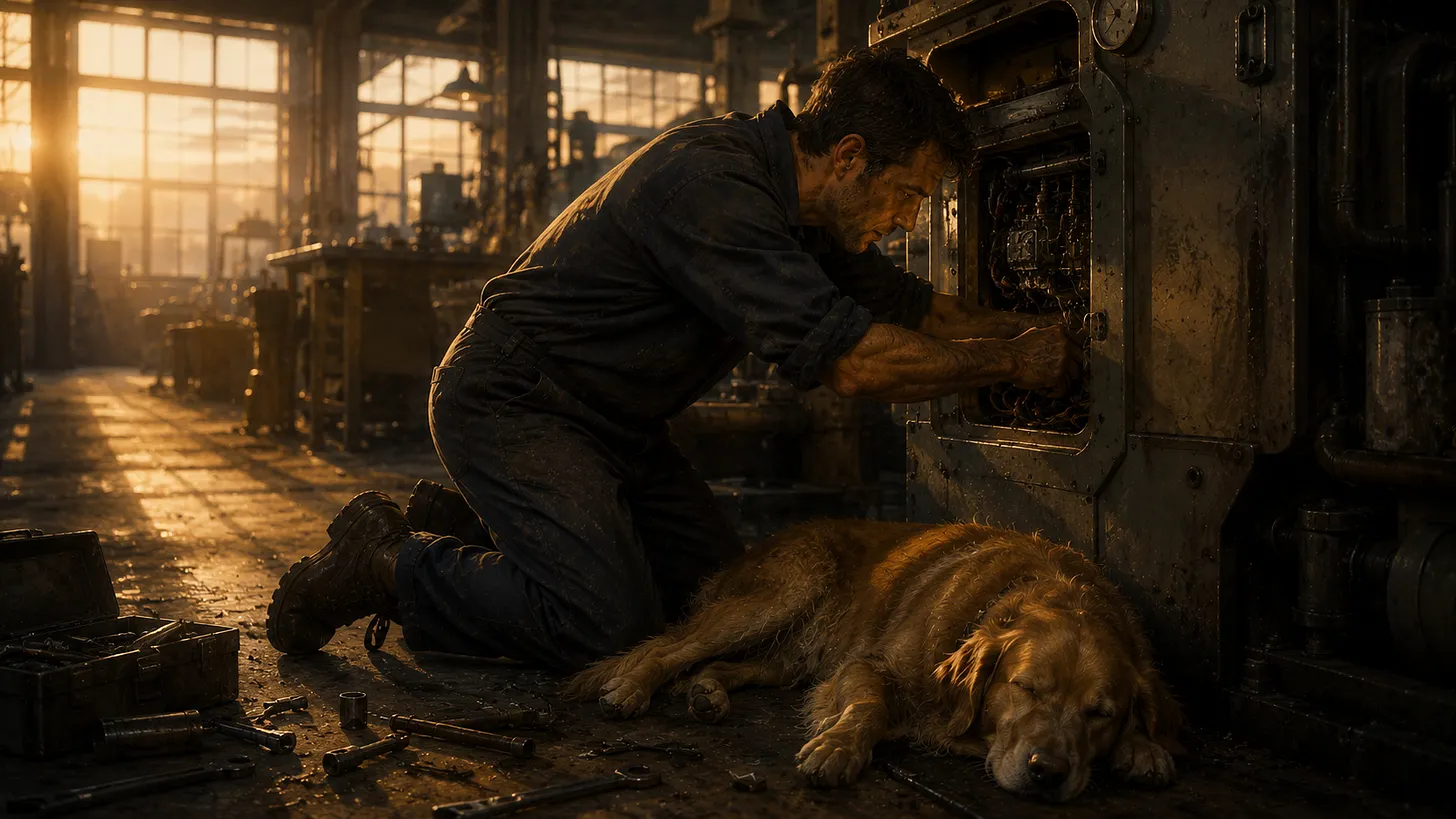
TL;DR: An old joke imagines a fully automated factory staffed by a man and a dog. The man is there to feed the dog, the dog is there to keep the man from touching the machines. The joke pictured humans locked out of the work. What is unfolding in front of our eyes is slightly different. The man keeps his job (for now), his title, and his salary, and hands the machine the one thing the joke never mentioned: the struggle. Learning science tells us the struggle is where understanding is built. Skip it for long enough and you become the man in the joke. However, that is a choice, we may remain employed, “in the loop” but unable to influence the machine outputs in any meaningful way.
“The factory of the future will have only two employees, a man and a dog. The man will be there to feed the dog. The dog will be there to keep the man from touching the equipment.” — Anonymous, popularised by Warren Bennis
A Joke With No Author
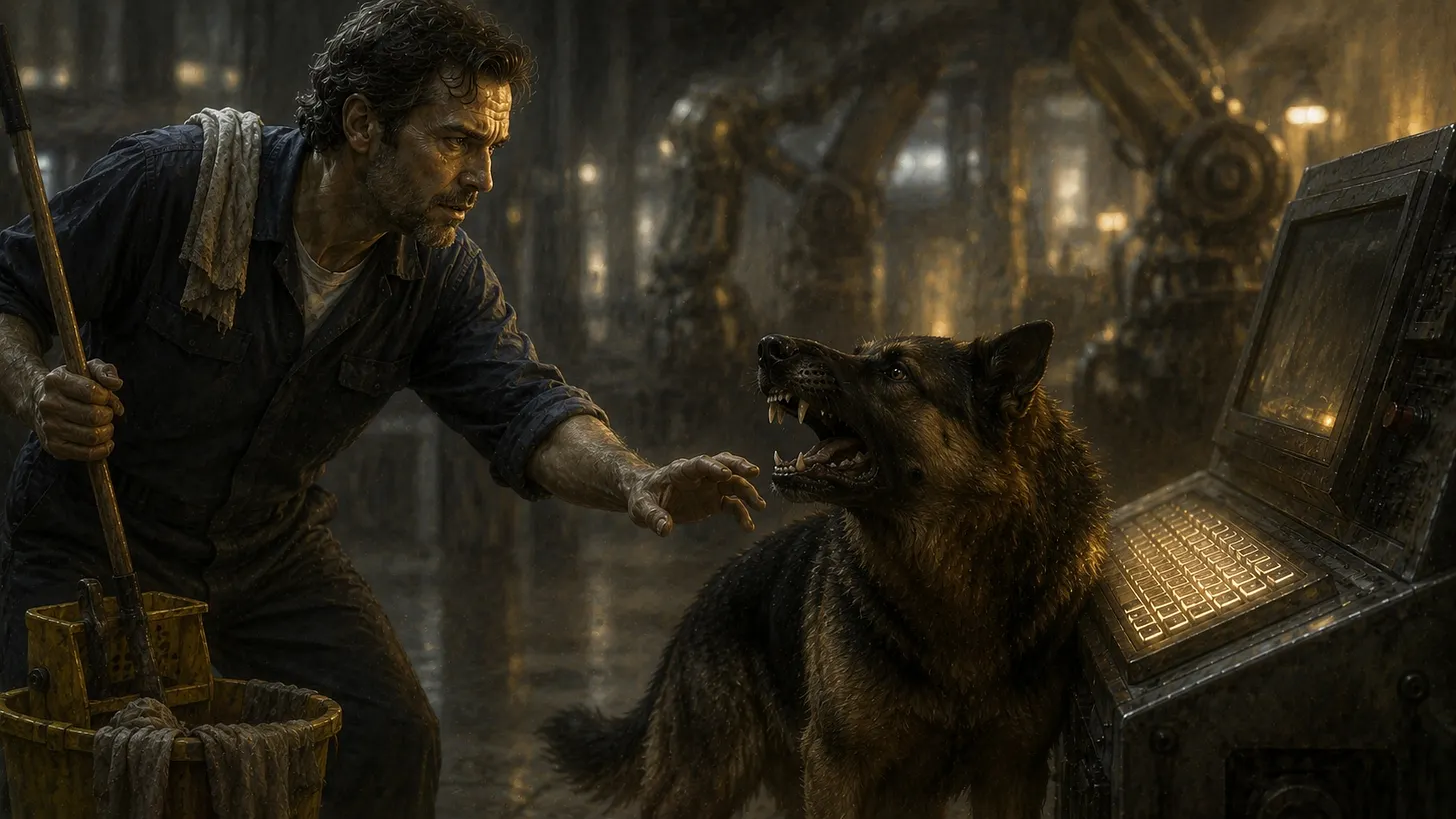
The joke has been circulating since at least 1978, when Datamation magazine printed it as the microprocessor began its march through the world’s factories. Yossi Sheffi of MIT cites that origin in The Magic Conveyor Belt, his book on supply chains in the age of AI. Warren Bennis, the great scholar of leadership, repeated the joke at a symposium in 1988 and again in his book On Becoming a Leader, and it has carried his name ever since. Bennis himself never claimed it. He introduced it with the words “someone said.”
There is something fitting in that. A joke about work passing out of human hands has itself passed through so many hands that nobody remembers whose work it was.
For decades the joke read as a warning about unemployment. The machine does everything, the human does nothing, and the dog is there to enforce the arrangement. Robots on the assembly line, algorithms in the back office, a shrinking space for people. That reading had a comforting clarity to it. The threat was out there, in the machine, and the victim was locked outside the fence.
The version unfolding now is less tidy. The man kept his badge. He is at his desk, replying to emails, attending the meetings, drafting the policies. From the outside, and often from the inside, nothing has changed. What has changed is invisible: he has stopped touching the machine. Not the machine on the factory floor. The machine in his own head.
The Obstacle is the Way
“Whoever puts in the effort to make sense, actually learns... you cannot get on a robotic swimmer and have it take you across the pool.” — Manu Kapur, The Innovation Show
In late 2024 I wrote a Thursday Thought called The AI Dilemma: Struggle or Shortcuts. It argued that struggle is where value and ownership are forged. This piece picks up that thread 18 months after many of us have been using AI tools. That one was about what the struggle gives us. This one is about what struggle’s absence takes away and the potential cost.
Manu Kapur, a previous guest on The Innovation Show, has spent a career demonstrating that we learn best when we struggle first. His research on productive failure shows that students who wrestle with a problem before being taught the solution end up with deeper and more durable understanding than students who are handed the correct method and then tested. Thus, the failed attempts are not waste, but a scaffolding on which we can build understanding.
In his experiments, students taught by direct instruction and students who struggled first looked identical on tests of basic knowledge. The difference appeared in how deeply they understood the why, and in whether they could apply the newly learned concepts in other ways. The path of struggle appeared optional right up until you probe for depth and transfer, and then it turns out the struggle was essential.
Now watch what happens when a student asks an AI to write the essay. The essay gets written (or simply copied, pasted and formatted), it even gets written very well (as a college professor it has become almost impossible to detect it). The student’s grade may even be excellent. But the cognitive excavation never happens. There was no groping for a structure, no false starts, no moment of realising an argument doesn’t hold or a metaphor doesn’t fit, no abandonment and no restarting. The student has an illusion of learning without any deep learning. They have the essay the way a tourist has a photograph of a mountain. They have the water cooler comment on the latest gossip they know nothing about.
Naomi S. Baron, linguist, author of Who Wrote This? and another guest of The Innovation Show, would say writing was never merely the packaging of finished thought. On the show she counted at least three centuries of writers testifying to the same discovery, condensed in a line she quoted, “I only know what I think when I see what I write.” The page is where the thinking happens. Hand the writing over and you have not saved labour on expressing your ideas. You have skipped the step where the ideas are formed through struggle.
There is a second-order version of this already visible on campuses.
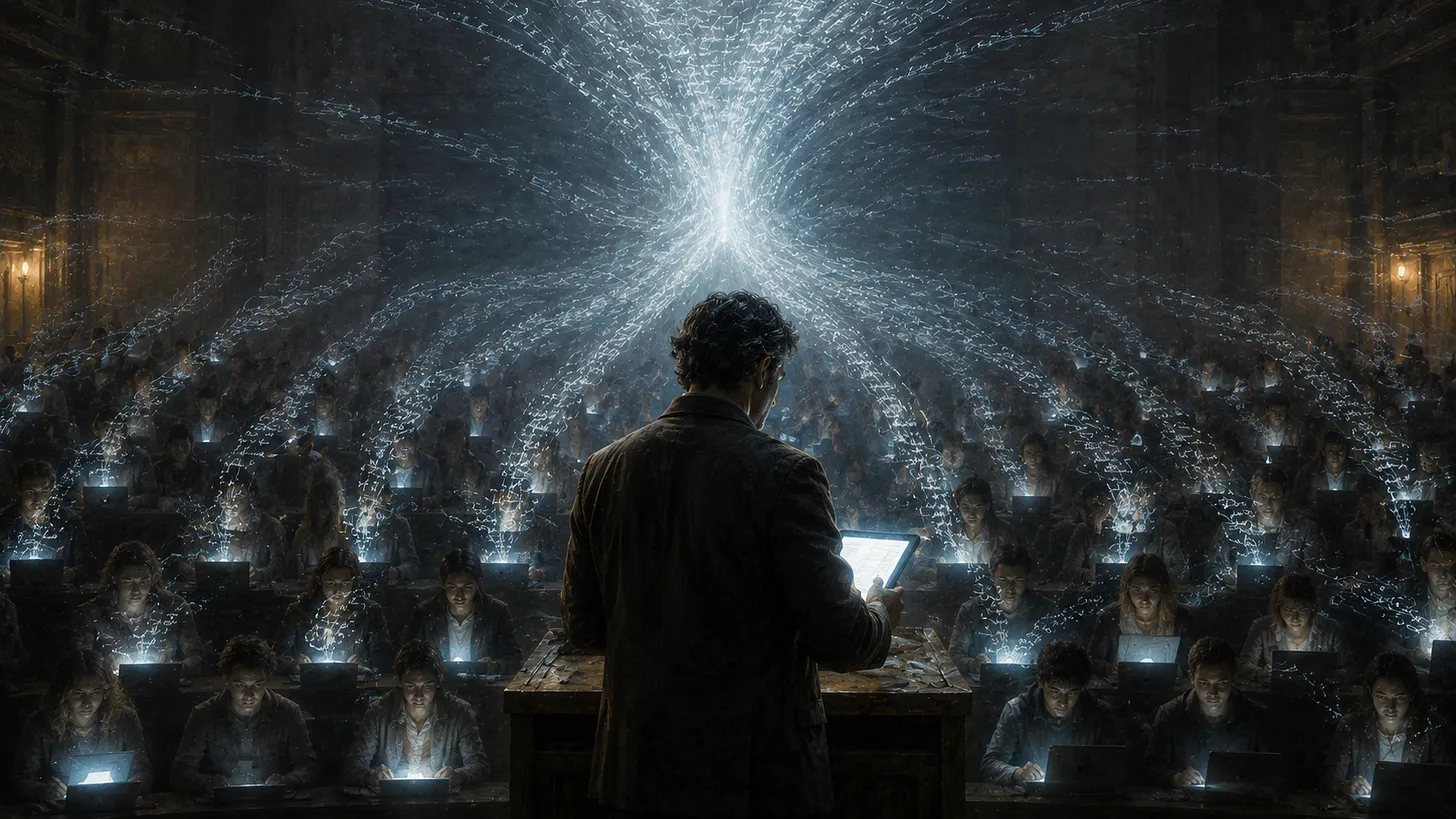
Picture the student who still attends every lecture, laptop open, capturing notes with real diligence. It looks like engagement. But the notes are not headed for the student’s head. They are headed for their model of choice. The student has become a data harvester, gathering raw material for the machine that will do the thinking, and the effort of harvesting feels enough like learning that the difference passes unnoticed.

There is a twist that turns that tragedy into farce. The lecturer may be running the same operation from the other side of the desk! Essays marked by a model, feedback composed by a model, their own papers and reading delegated in the same way, maybe they pay for a better model, but they still pay the same ultimate price. They pay with learning, they pay with cognitive atrophy.
When this happens the loop closes. A machine writes the essay, another machine grades it, and two human beings stand at either end of the exchange, feeding the process while understanding none of it (deeply anyway). The man and the dog, writ large, with a lectern dividing them.
Universities are redesigning assessment around the visible half of this problem.
However, what we rarely discuss is that a similar transaction is happening in offices, among adults, on work that matters considerably more than a term paper.
Still in the Loop, Just No Longer in the Work: A Faust-AI-n Bargain
“In a time of drastic change it is the learners who inherit the future. The learned usually find themselves equipped to live in a world that no longer exists.” — Eric Hoffer, Reflections on the Human Condition
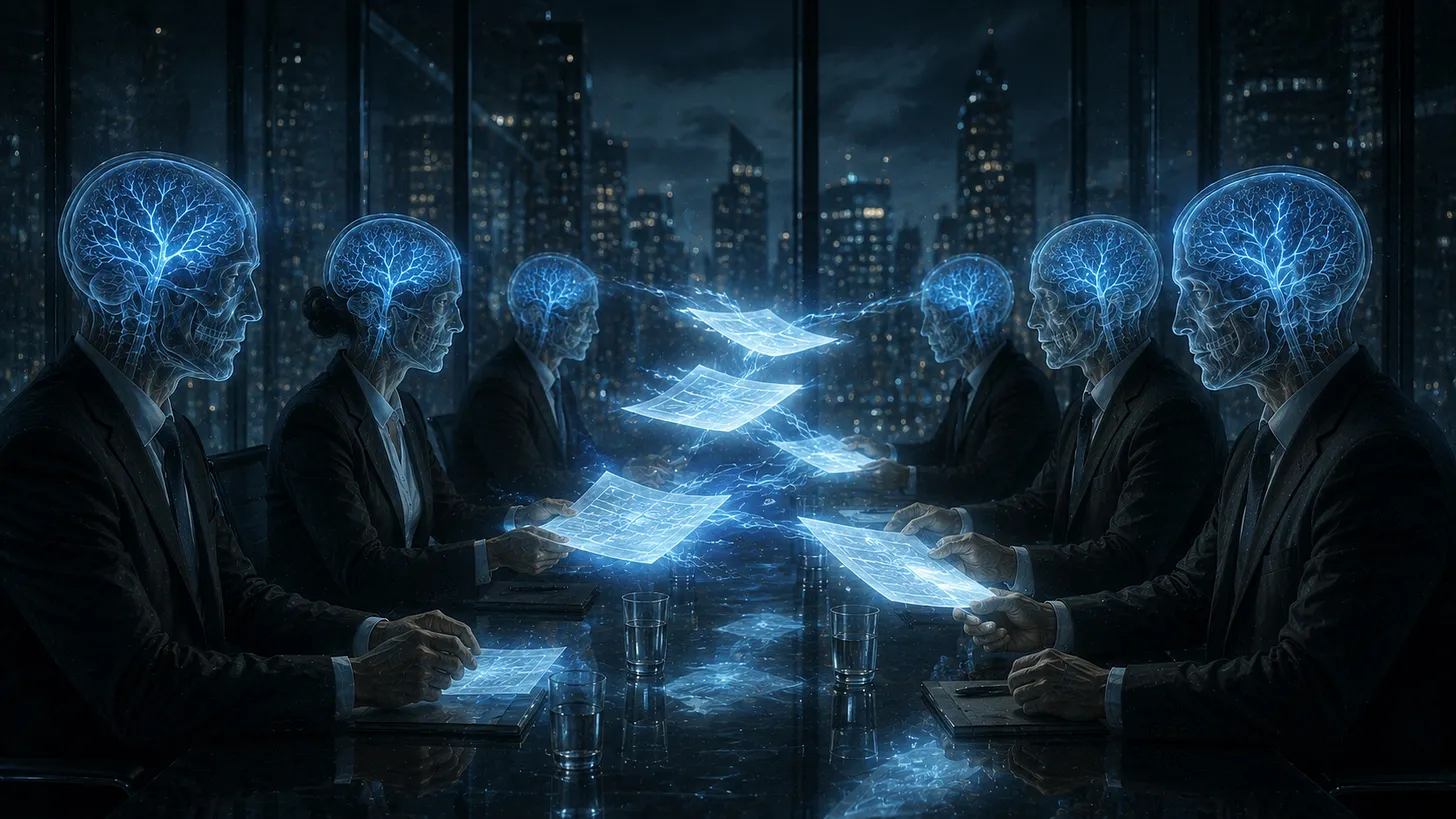
Picture a risk department in a large firm. A manager is asked to draft the policies governing some potential exposure. She prompts a model, which produces a competent draft. She skims it, gets the gist, adjusts a phrase or two to fit company vernacular, acronyms, jargon, and circulates it. Her colleagues, pressed for time (or attention), feed the document back into their own models to summarise it and reply with comments their models (partially or entirely) compose. The documents flow. The meetings happen. Everyone is professional, responsive, and busy.
At no point in this loop has anyone gone through the struggle the subject actually requires, namely the slow, frustrating work of holding the information in your head, testing it against scenarios, ruminating on it, discovering what you don't understand and eventually closing the gap. The legendary basketball coach John Wooden captured this challenge when he advised his players to "never mistake activity for achievement." The policy exists. The comprehension it is supposed to represent does not. It is a photograph of a gym membership nobody uses.
For a while it goes undetected, because the outputs appear otherwise be good and even better than we used to get. (One manager said to me, they are getting 3-page-PDFs from people who previously never strung a paragraph together). That is precisely the trap.
In The Magic Conveyor Belt, previous guest on the Innovation Show, Yossi Sheffi shared that humans and machines hold complementary capabilities. The machine takes the repeatable, while the human is (should be) retained for judgement, for the moment something arrives that sits beyond “what the machine was programmed or trained to do.” It is a perfectly rational division of labour with a hidden dependency, because the (Faust-AI-n) bargain only works if the human still possesses the judgement they are being retained for.
The whole reason a firm employs the risk team is for the day conditions change, the day an anomaly appears that doesn’t fit in a file, when what is needed is a human in the loop who understands the entire terrain. That capacity is built only one way, and it is the way everyone in the loop has practised skipping!
Muscles atrophy without load. So does judgement. The worrying part is that the badge still works, the title still holds, and the calendar is still full. Atrophy of this kind is not a firing. It is a hollowing. Keep a person in the loop while the machine absorbs every rep, and on the day the exception arrives, the safety mechanism is an empty uniform.
Last week’s guest, Usman Sheikh has a name for what the loop produces. He calls it judgement-shaped artefacts. The machine’s brief “doesn’t have judgement in it, but it’s judgement-shaped,” he told us. Someone who has never built a brief will think the machine’s version is excellent, it seems great and nobody denounced it so all good, right? Someone who spent years building briefs by hand can see the four places this one went wrong. Grading the output is the last human contribution that matters, and it is available only to the people who actually do the reps.
Usman also points to where this compounds. The professional pyramid was never only a delivery structure; it was also an academy of sorts. Juniors did the low-grade work, seniors corrected their errors, and through reps of supervised struggle those juniors built the muscle that prepared them to become people who could one day put their name on a document. And all of it paid for by the client through the billable hour.
Today, AI does the low-grade work. The firm keeps the margin, the client gets the outcome, but the apprenticeship that ran below the radar has dried up. His advice to one junior leaning on the machine was to do the work by hand so you can grade the output, because “the machine gets more reps at it than you do.” Skip those reps and you become, in his words, fluent and substitutable. At that point the man and the dog is no longer one worker’s story. Remove the base of the pyramid and an entire profession stops producing the people who could touch the machine.
The Gods, the Useless, and a Third Group
“Tomorrow’s illiterate will not be the man who can’t read; he will be the man who has not learned how to learn.” — Herbert Gerjuoy, quoted by Alvin Toffler in Future Shock
Yuval Noah Harari has warned of a future divided between an enhanced elite and what he calls a useless class. The people who, through no fault of their own, hold no economic or military value in a world of intelligent machines. In his telling the divide is largely a matter of access. The gods will be those who can afford the enhancements, biological and digital, and the useless will be those priced out of them.
It is a dystopian vision, and the widening wealth-gap version of it deserves the attention it gets. But the joke about the man and the dog reveals a third group. What about the people who have every advantage, full access to the most capable tools on earth, and who use that access to stop doing the struggle that made them capable in the first place?
Nobody excluded them. They literally subscribed their way into uselessness, one accepted draft, one unexamined token at a time, upgrading from each model to the next while their performance reviews stayed excellent, but their ability and attention waned. The subscription price rose with every upgrade. So did the cost.
Exclusion, at least, is visible and can be fought. This neglect is voluntary, comfortable, and invisible, which makes it more dangerous. The man in the joke was put in the factory with nothing to do. We, his modern descendants, put ourselves there one prompt at a time, but we brought our laptops.
Touching the Machine
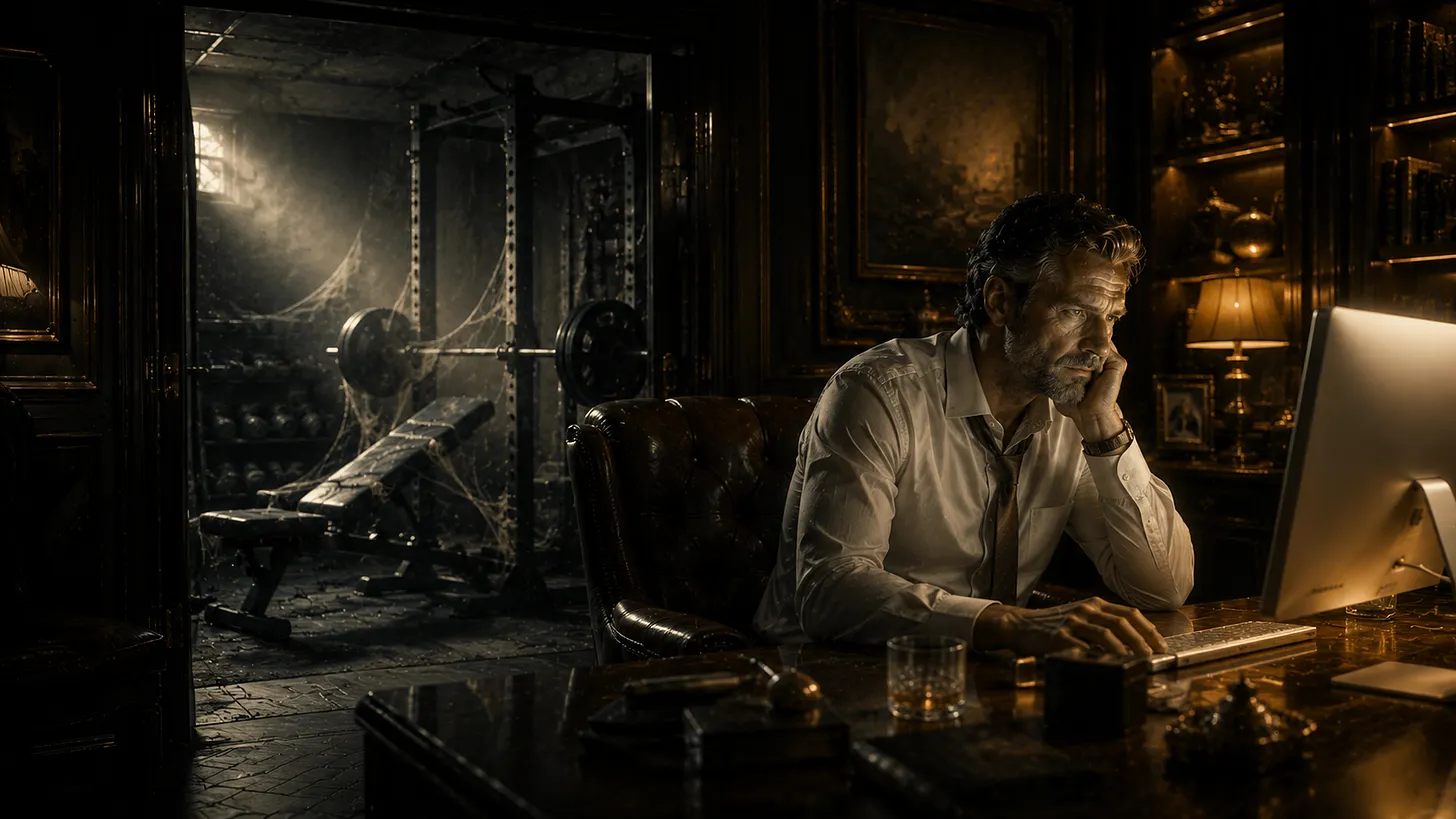
There is a distinction my own routine has taught me, and I have to hold myself accountable, because I have used AI for a long time now. Marination (of ideas) is the creative piece. Marination is the walking away, the letting an idea sit and combine below the surface. Writing is the struggle piece. Both are work, but they do different jobs. Marination generates the thinking, and the struggle engrains it. An idea that arrives fully formed (for me in the gym, for some in the shower, for some on a walk) still belongs to the gym session until it has been wrestled onto the computer screen. That is the step the machine tempts us to skip. However, it is precisely the step where the thinking truly becomes ours.
When I raised this with Manu Kapur on the show, he offered a test I have used ever since. Ask this of any task. Is this a learning event or a performance event? If you already hold the expertise, reaching for the tool is performance, converting two hours into twenty minutes; the skill was banked long ago and the machine is spending it, not replacing it.
However, if you do not yet hold the expertise or the knowledge, the same shortcut is fatal. As he put it, a novice using AI to write “can perform well, but you’re not going to learn how to write... because the writing is being done by the AI.”
Naomi Baron used the great composers to make a similar point. Bach could not have agonised over every cantata and still filled his catalogue, and the later Picasso painted fast because the younger Picasso had learned slow. Fluency is the dividend of struggle already banked. The danger of this moment is a generation drawing down the dividend without ever having made the deposit.
I should say openly that this piece was built with AI in the loop, and I felt the dog’s teeth tugging on my own ankle while writing it. The test I hold myself to is Kapur’s, could I stand on a stage tomorrow, without the document, and argue this from the ground up? Yes I could because this article has been marinating for over 3 years. The struggle is to write it in a coherent way.
The reading, the interviews, the years of circling these ideas are the excavation. The draft is scaffolding on a site I dig myself. The day that stops being true, the tool has stopped serving my work and started replacing the worker, and I would be the last to notice.
That is the honest difficulty for all of us.
Atrophy has no alarm. An elderly person falls and breaks a hip, but did they break a hip and fall? Did they lack the scaffolding to keep themselves upright? Nobody feels their understanding thinning in real time, any more than the man in the joke felt the moment the machine stopped needing him.
The only reliable defence is to keep up the practice. Continue to pick the work that matters most, the risk policy, the strategy, the argument you will have to defend, and do the first struggle yourself. Read the difficult document. Write the bad draft. Sit with the problem before you prompt for the answer. Earn the right to accept the machine’s help by being able to check what it produces.
The joke has one more thing to teach.
Warren Bennis, who spread it around the world, was careful to say it wasn’t his. He kept the attribution honest even when the world kept handing him the credit. That is an admirable posture worth keeping in the age of very capable machines. Always crystal clear about which work is yours and which you simply prompted.
Feed the dog we must, indeed it would be a competitive disadvantage not to, but let's keep working on the machine. Let's keep our brains in the loop.
From The Innovation Show
Every thinker named in this piece has sat across from me on The Innovation Show:
Manu Kapur on Productive Failure, a two-part conversation on why the struggle is where the learning lives.
Naomi S. Baron on Who Wrote This? How AI and the Lure of Efficiency Threaten Human Writing.
Yossi Sheffi on The Magic Conveyor Belt and what AI means for work and supply chains.
Usman Sheikh of High Output Ventures on the shape of the new firm and what AI does to the professional pyramid.
Coming tomorrow
Keith McCandless, co-author of Liberating Structures, joins me for a two-part episode. This piece asked what happens when we hand the struggle to the machine. Liberating Structures is a field guide to the opposite move: simple methods that put every person in the room back into the thinking. The timing is serendipitous.
Bonus previous article