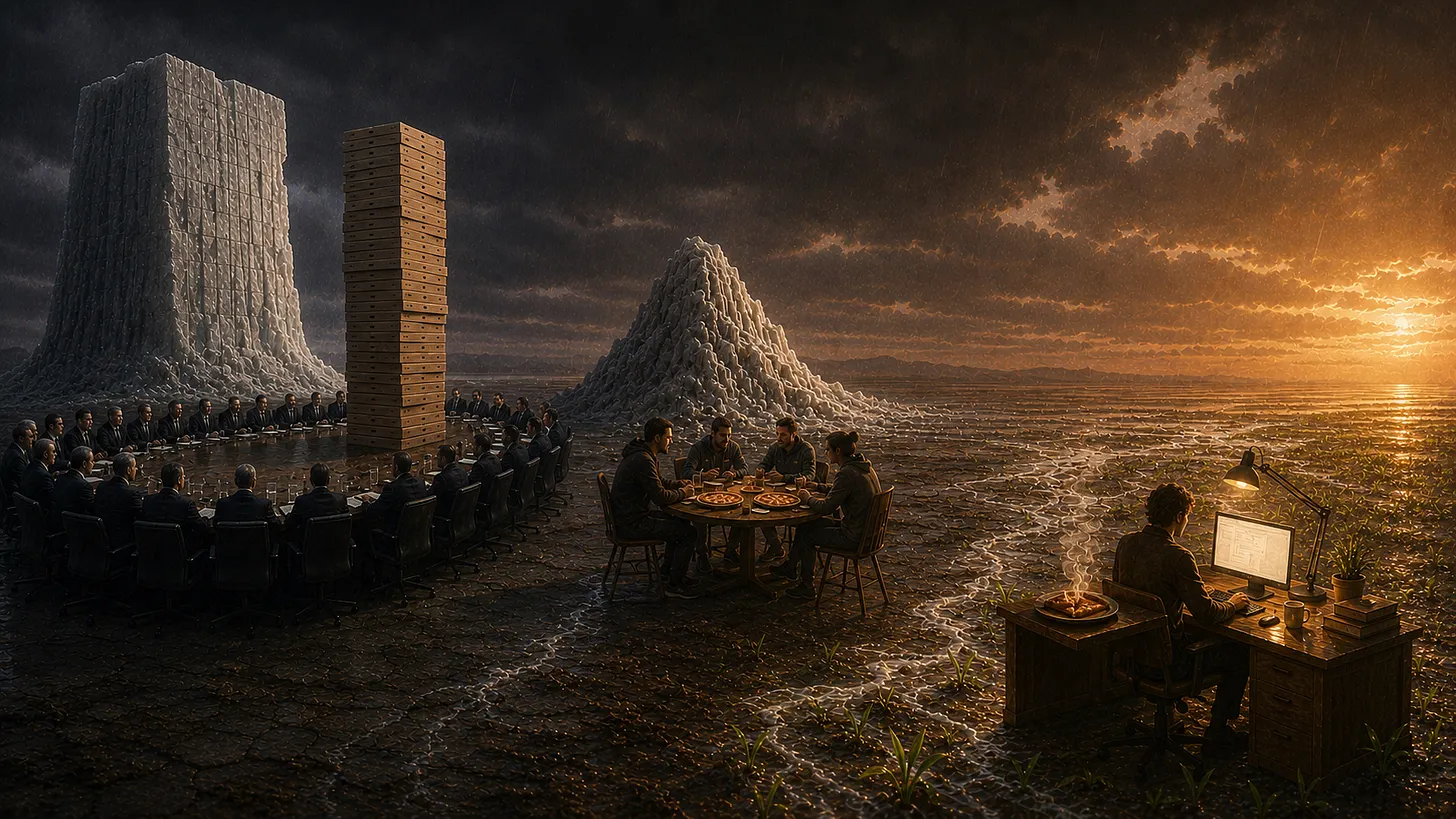
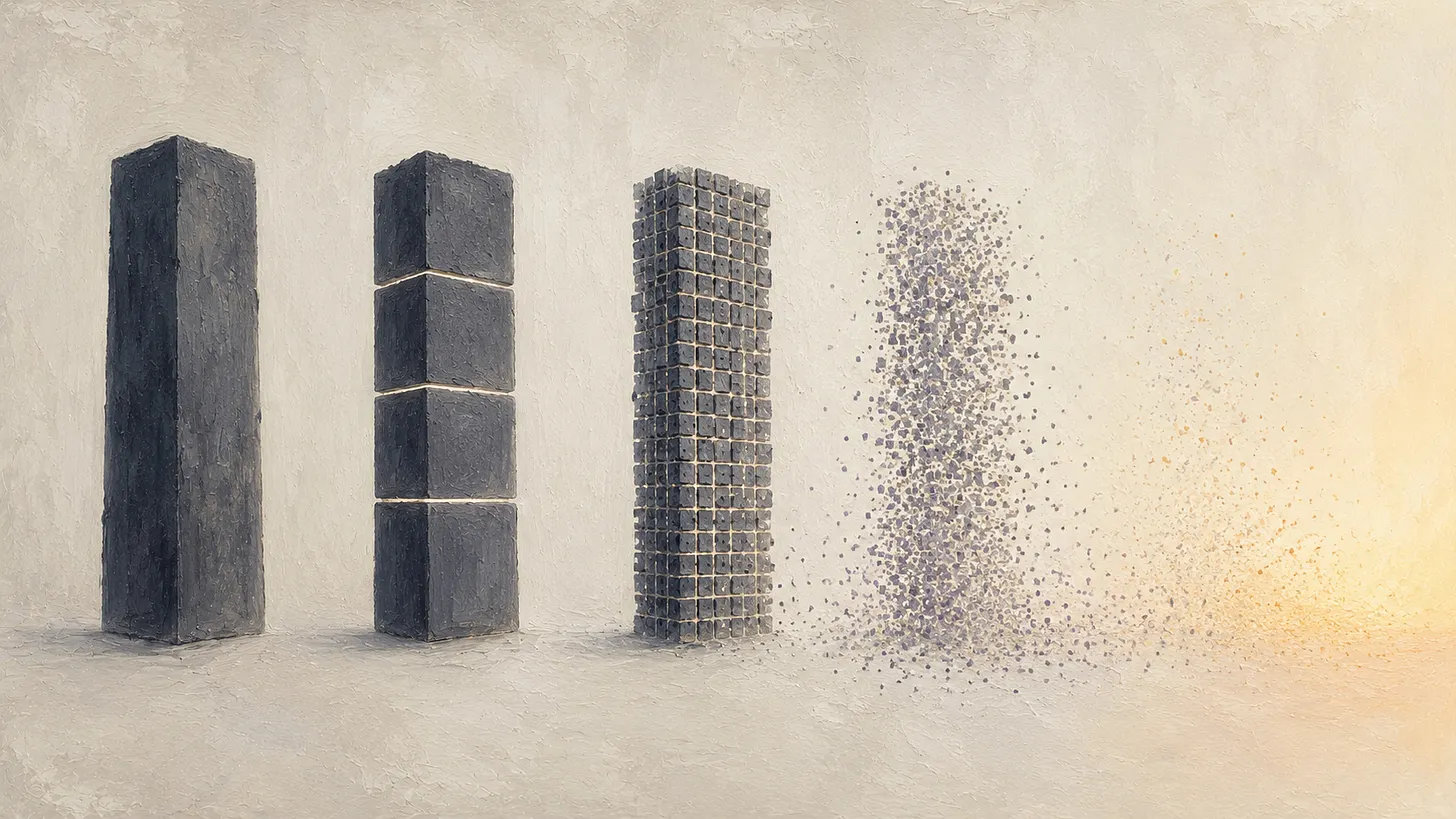
TL;DR: Every era of computing architecture has produced a matching organisational form. The integrated mainframe era built monolithic hierarchical organisations. When the architecture broke into modules, the pillar split into blocks and gave us divisions. When cloud computing arrived the blocks were ground into flakes (like Amazon’s two-pizza teams, each holding its own slice of the stack).
Today, AI is grinding the flakes into grains, and those grains are beginning to dissolve.
Base44, a bootstrapped company with a sole shareholder and eight employees, sold to Wix for $80 million within six months of launch. The two-pizza team is becoming the two-pizza company, and the two-slice company is next, that’s if they eat pizza at all.
You can point to a pillar, a block, a flake, a grain on a tablecloth. You cannot point to salt in water.
You can only taste it after the fact.
"Some will change shape. Few will keep the gain" - Usman Sheikh
The Salt Cellar

Last week during a breakfast meeting, a senior executive and I discussed the impact of AI on the business world. He shared his thoughts and my reply needed a prop, and the table happened to be set with one.
I stood the salt cellar as a pillar between us. The corporation of the last century, one heavy object, everything in one place. I pointed to the flakes of sea salt on our plates, the era we have just lived through, small teams, each distinct, each holding its own edge. Then I tipped the cellar and spilled a few grains across the tablecloth: the companies forming now, tiny, numerous, complete in themselves. And finally I dropped a pinch into my glass of water, which mostly dissolved.
This week’s Thursday Thought is the text version of that answer.
First Came The Pillar
For most of the twentieth century, computing had a pillar of its own, and it stood for good reasons. Vertically integrated IBM made the hardware, wrote the operating system, built the peripherals and fielded the sales force. Everything was interdependent and nothing was separable. When every part of a machine depends on every other part, the only organisation that can build it is a single hierarchy. The company was one mass because the product was one mass, cut from one seam.
Every era begins as a pillar. The danger arrives when the world changes shape and the firm keeps its own. And the challenge compounds, because a firm changing shape also changes the environment around it. As Alan Watts put it, "the environment grows the organism, and the organism creates the environment."
The Blocks
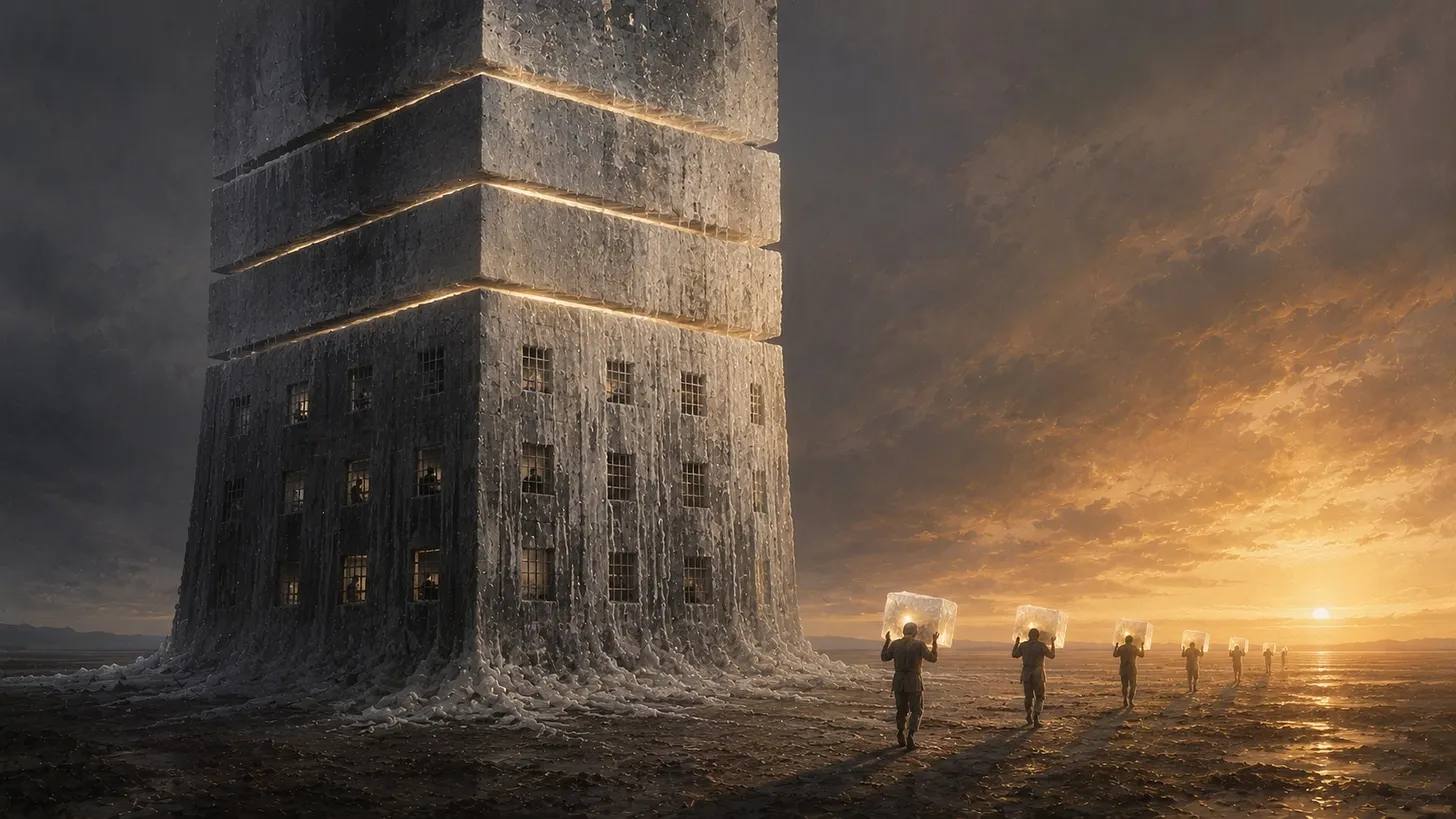
By 1960 the pillar had become a prison for IBM. “Big Blue” sold systems built on 8 different processors, and 6 of them used different data formats and instruction sets. Each new computer was designed from the ground up. A program written for one machine was useless on another, the knowledge a programmer built on one system transferred to nothing else, and IBM’s biggest customers were telling the company exactly how unhappy they were.
The bigger problem was a lack of agility. Because everything depended on everything else, a change to any part meant rebuilding the whole pillar. When Kim Clark joined us on The Innovation Show alongside Carliss Baldwin, they shared how breaking the pillar down was the only way out. IBM was living through an innovator’s dilemma decades before Clark’s friend and colleague at Harvard, Clayton Christensen, gave the dilemma a name.
In the autumn of 1961, Vincent Learson, the executive in charge of IBM’s North American computer divisions, sent 13 people from research, development and marketing to the Sheraton New Englander motel in Connecticut. The task group was code-named SPREAD. 8 weeks later they delivered their report. IBM should walk away from its entire product line and build a single compatible family of 5 new processors, machines that would run one another’s programs through standard interfaces, compatible with each other and with nothing IBM had ever made.
The result was System/360, introduced in 1964. It was the first truly modular computer design, and according to Carliss Baldwin and Kim B. Clark the most valuable line of computers any single company had ever produced. For 5 years afterwards, IBM’s market cap exceeded 150 billion dollars in 1996 money.
The pillar had proactively cut itself into blocks, a self-cannibalisation of sorts.
What nobody at the Sheraton motel foresaw was that those blocks would soon leave IBM. In December 1967, 12 engineers walked out of IBM’s San Jose lab, the home of its disk drive research, to start a company of their own.
Back in IBM they became known as the dirty dozen. They carried with them System/360’s “design rules”, its architecture, its interfaces, its tests, and within 6 months they had built an IBM-compatible drive that was faster and cheaper than IBM’s own. Soon, a stream of engineers followed them. By 1970 the plug-compatible makers held 11% of the tape drive market, and between 1970 and 1996 the industry transformed from a virtual monopoly into what Baldwin and Clark call a modular cluster of more than 1,000 publicly traded firms standing where one monolith pillar once stood alone.
The same interfaces that let IBM’s machines talk to each other let everyone else’s machines talk to IBM’s.
Once a block was cut, anyone could now carry it.
The Flakes
In 1998 Amazon ran on a single monolithic “bookstore” application and one giant database. Every team worked on the same codebase and adding video streaming meant rewriting vast amounts of code originally written for selling books. Amazon’s Chief Technology Officer, Werner Vogels, called it “a long, unwieldy process requiring complicated coordination.”
Guided by its Distributed Computing Manifesto, Amazon broke the monolith into microservices, and broke its functional hierarchy into two-pizza teams to mirror that architecture. Each small, autonomous team owned its portion of what had been the monolith, with its own developers, businesspeople, and design staff. In founder Jeff Bezos’s view, "A hierarchy isn't responsive enough to change". The people closest to problems are best positioned to solve them. Deployment went from dozens of features a year to millions.
Uber ran the same play: one city, one product, one monolith, then geographic and product growth until, as engineering manager Einas Haddad put it, “Tribal knowledge was required before attempting to make a single change.” (See “The Ground Remembers”) From 2012 Uber decomposed itself into microservices. Today more than 2,200 of them, refined further into Domain-Oriented Microservice Architecture.
The flakes keep getting finer.
The Grains

Maor Shlomo sold his bootstrapped vibe-coding startup Base44 to Wix for $80 million in cash within six months of launch. Solo founder for most of the journey; he hired the first employee roughly six weeks before the acquisition. By his own account, he went months without writing any front-end code because AI handled the implementation. Only 8 employees at the time of the deal, a whole company you could have fed with two pizzas!
The Solution (Not That Kind of Solution)

Why did the grains only appear recently?
Amazon’s two-pizza team has existed for two decades, yet for all the autonomy it provided, the teams stayed inside the container of a corporate org structure. Amazon held the capital, signed the contracts, employed the lawyers and carried the liability. The pizza teams owned their slice of the stack, and the parent owned everything that made owning possible at all. A team that dared to walk out the door would have had to rebuild all of that from scratch.
Then things changed.
The corporate wrapper became rentable. Computing is billed by the second, payments arrive through an interface, and incorporation, agreements and distribution are services now. The administrative organisation, the part of the firm that once justified its scale, has turned into a subscription.
Then change happened to a quieter job: translation. In Design Rules, Baldwin and Clark describe translator modules. These are the connectors that let one system speak to another, and they reveal why translating in real time cost so much, in design effort and in performance, that it was often easier to rebuild a module from scratch than to connect it.
Every organisation employs the human equivalent.
These are the integration teams, project managers and coordinators who spend their working lives carrying meaning between systems that were never built to meet. AI can now perform that same translation continuously, between codebases, between formats, between a founder’s intent and working software, at a cost approaching nothing. The work an entire discipline was built to ration is now everywhere and almost free.
Take away the need for a corporate parent, take away the human translators, and what remains at the table is a founder and their agents. And the agents don’t eat pizza.
The glass from that breakfast is worth one last thought. The salt is all still there. Every grain of it is in the water, some dissolved, some not yet.
The firm is heading the same way. Capability remains, dissolved out of the structures that used to hold it and into the tools everyone now works with.
You can point to a pillar, to a block, to a flake or to a grain on a tablecloth.
It is very difficult to point out dissolved salt in water.
You can only really taste it.
On this week’s Innovation Show, we welcome the founder of High Output Ventures and Frame Break, Usman Sheikh, to explore The Shape of the New Firm.
When answers get cheap, who still gets paid for judgment?
Usman explains why AI produces “judgment-shaped artifacts,” work that looks right to everyone except the person who has done it for a living, and why pressing the button again turns the most powerful tool ever built into a slot machine.
We trace the professional services pyramid, one flow of billable labour doing three jobs at once, and what happens when the productive base shrinks before the accountable apex: the client-funded apprenticeship ends, and the missing experts only show up years later. Offshoring changed where the work got done. Workflow software changed how. AI changes who.
Along the way: the AI discount arriving in audit fees, why the firm of the future morphs from a pyramid into a ring around an owned intelligence core, the incumbents playing musical chairs as the chairs are carried away, and why some will change shape but few will keep the gain.
The episode will be live at the links below