

TL;DR: In the age of AI, many companies are chasing productivity, and very few are reinvesting the efficiency gains in reskilling, upskilling and growing their people. Efficiency releases energy, and organisations almost always choose (directly or via their shareholders) to harvest that energy rather than reinvest it.
The same thing happens to people.
The worker who finishes early is given more work, so the fastest people learn to slow down. Christensen, Ojomo and Dillon put the alternative in a single parenthesis in The Prosperity Paradox, that efficiency gains only create jobs if the freed capital is funnelled into building new markets.
Ingka Group, IKEA’s largest franchisee, offers a rare example, reskilling the 8,500 call centre workers its bot displaced and building a billion-euro business with them.
“Quarterly earnings are the score; customer-pleasing, competitor-slamming innovation is the game.” — Gary Hamel
The Work in the Weeds
“Work expands so as to fill the time available for its completion.” — C. Northcote Parkinson, Parkinson’s Law, or the Pursuit of Progress
When I was a boy, an acquaintance of my parents asked whether I would be interested in a paid job to pull the large weeds from her garden. She and my mother settled in for a cup of tea to chat. Being bored, I decided to get started, and I finished the job before they finished the tea. When I came back inside, the mood had shifted in a way a twelve-year-old couldn’t understand. The job was done before the pay had been agreed, yet the work now seemed worth less because I had been so efficient. That afternoon taught me the lesson every fast worker learns eventually, and often the hard way. If you finish early, the work looks like less.
Decades later the lesson repeated itself in the workforce weeds. I had just moved from an entrepreneurial company into a large, bureaucratic public organisation. My first assignment was to take over with a client who was frustrated with the lack of progress on a collaborative project. I was used to delivering at speed, and believing I was fixing the very thing the client had complained about, I was reprimanded by my boss. Delivering that quickly meant the organisation could charge less for the work. I lasted eight months.
Writing in The Economist in 1955, and in a book two years later, C. Northcote Parkinson presented a law that now carries his name. His opening example was, fittingly, an elderly lady of leisure, who could fill an entire day with the writing and posting of a single postcard (as a former pro athlete, I did the same, nothing to do with age :). Parkinson noted that between 1914 and 1928, the Royal Navy’s capital ships in commission fell from 62 to 20, its officers and men from 146,000 to 100,000, but Admiralty officials grew from 2,000 to 3,569. The fighting fleet shrank by two thirds while the administration of it grew by more than three quarters.
If work expands to fill the time available, then time saved counts for nothing on its own. An organisation can do two things with the efficiency, it can refill the hours with more work, or rate the work as less valuable because it took less time.
Visa founder Dee Hock shared with us the same education in his series on the show and his brilliant book, One From Many. Arriving at the head office of a finance company in the 1950s, he was given a weed-like task that needed no more than an hour. Visitors were confused about the location of the executive offices, and a sign would fix it. As he reached for the telephone to call a sign company, an experienced colleague hung up the phone and proceeded to show him how to make the minutiae last months. His colleague educated him in Parkinson’s law before Parkinson even wrote it. He showed how he would “need” to solicit opinions on which signs looked best, then sketches of variation and of course decisions by committee. The lesson, as his bureaucratic teacher put it, was that in companies like this, “procedure is more important than purpose, and method more important than results”. Dee watched one of the most intelligent men he had ever met, bored to death by his own job, make an industry of what should have been an afterthought.
The Fastest Person on the Team

Think of the person who takes a new tool home over the weekend, creates a new template everyone else borrows, who gets Friday’s work finished by Thursday. Watch what happens to them. Friday always arrives early, they are given next week’s tasks before the week begins. The colleague who paces themselves keeps a manageable plate, while the fast one’s plate is refilled as soon as they empty it. Their speed creates spare capacity, and the organisation snaps it up.
Stay watching and you will see how the fast worker learns to slow down, or (like I learned) to keep any surplus hidden and spend on the important things. Either way the organisation has taught its most inventive person to slow down. The pattern is common enough to have its own name, performance punishment, and the evidence that it is the default setting rather than a local failure is now unusually strong.
Microsoft’s 2026 Work Trend Index surveyed 20,000 workers using AI across 10 countries. Some 65% of AI users fear falling behind if they do not use AI to adapt quickly, while 45% say it feels safer to focus on current goals than to redesign how they work. Only 13% say they are rewarded for reinventing their work when the results do not arrive immediately. Microsoft calls this gap the Transformation Paradox. The same forces driving adoption at the level of the individual are suppressing it at the level of the institution. Atlassian’s State of Teams research completes the picture from the other side. In the 2024 edition, 65% of knowledge workers said responding quickly to messages matters more than making progress on their top priorities.
By the 2026 edition, it now appears that knowledge workers who use AI daily carry 2.3 more projects at any given time than those who use it less. Visible responsiveness is rewarded, but the reward for adopting the tools is more plates to spin on sticks. Invisible reinvention is punished, or at best absorbed without reward, recognition or remuneration.
The Scoreboard and the Game
“You end up with a company filled with denominator managers who know everything about how to cut head count and how to reduce costs and know nothing about how to grow the top line.” — Gary Hamel, The Innovation Show, Competing for the Future
Organisations are doing to themselves what they do to their fastest people. Productivity is a ratio, with revenue and profit on top and investment and headcount underneath, and there are two ways to improve it. A company can grow what it produces, or shrink what it uses to produce it (akin to Parkinson’s findings with the Admiralty ratio). Hamel and Prahalad observed 30 years ago that management prefers the Admiralty route, because shrinking the denominator can be done by decree, while growing the numerator requires imagination, deviance and risk. The result is that productivity improves for a while, the top of the ratio then shrinks for want of investment, and another round of what Hamel and Prahalad called non-elective surgery follows, until investors hand the remains to a new owner. (Like buying a dud house where the previous owner papered over cracks or VC put lipstick on the pig).
Consider that in 1980, roughly 220,000 people worked in American oil and gas extraction, producing about 8.6 million barrels a day. By 2017 the workforce had fallen by more than a third, to around 146,000, while daily production had risen past 9.3 million barrels. More output from far fewer people, year after year, and almost no new jobs created along the way.
Strategy has a polite name for the deliberate version. The aptly named harvest strategy takes a business that has stopped growing, cuts investment in innovation, marketing and support, and extracts the remaining cash before the thing is wound down. For a product at the end of its life that makes sense. The trouble is that the same harvesting diminishes capabilities. As a company climbs the learning curve it needs fewer expensive experts per head, so it tightens the spigot on developing talent, and revenue can double for a few years while the ranks of people able to build the next business barely grow. That is fuelling the present with the future or eating the seed corn.
Keynes saw the incentive behind all of this observing that “worldly wisdom teaches that it is better for reputation to fail conventionally than to succeed unconventionally.” Harvesting is exactly that, conventional failure.
Reinvestment is unconventional risk, so why take that route?
Unless
“...unless the capital these innovations free up is funneled back into developing market-creating innovations.” — Clayton Christensen, Karen Dillon and Efosa Ojomo, The Prosperity Paradox
While re-reading The Prosperity Paradox before interviewing Efosa Ojomo for our Clay Christensen series, I came to the passage on efficiency innovations, the innovations that let companies do more with fewer resources. Efficiency innovations are crucial for viability as industries grow crowded, they free up cash flow, and they are good for the productivity of an organisation while being hard on its existing employees, anyone who worked through the 2009 crisis and in some cases the pandemic experienced this implicitly. By themselves, efficiency innovations tend to eliminate more jobs than they create. They tend not to create jobs, unless the freed capital is funnelled back into developing market-creating innovations.
Everything turns on that unless.
These three types of innovation are read as a ranking, with efficiency at the bottom. It is better to read them as a sequence where efficiency innovation releases resources for market-creating innovation.
A firm under margin pressure that concentrates solely on efficiency may feel productive while merely rearranging the deckchairs on the Titanic. They are only performing the first half of a sequence and calling it a strategy. My friend and next week’s guest Paul Nunes says that freeing capital in the old business achieves little without plans to invest those funds wisely in scaling the new. What he and co-author Tim Breene call high performers (top of the class companies they studied) treat deliberate shrinking and divesting as a healthy part of the cycle, precisely because release is what makes reinvestment possible.
Listening back to that episode with Efosa Ojomo (embedded below) while preparing this Thursday Thought, I found the seed (not seed corn) of the piece already planted. I had put it to Efosa that so many of our audience for the show and readers of this publication (you) spot market-growing opportunities that require the very money saved by efficiency. However, they end up watching those savings being harvested instead. Efosa’s reply was that efficiency innovations exist to free cash flow, and everything turns on what you do with that freed cash.
Return to investors via dividend, of course, but don’t return the seed corn, unless you want to put the golden goose on life support.
Which brings us to a company that provides a fantastic contemporary example.
Fifty-Three Per Cent
“Strengthening co-workers’ employability ... and to accelerate the creation of new jobs.” — Ulrika Biesert, Ingka Group, to Reuters, 2023
In 2021, Ingka Group, the largest of the IKEA franchisees, launched a customer service bot called Billie, named after the bookcase (the very six I have around me now to house the innovation show books and my record collection). Over two years Billie handled roughly 3.2 million interactions and resolved about 47% of the enquiries that passed the “give me a human agent” input (mea culpa). This saved close to €13 million in operating costs. On the usual scoreboard, the story ends there, profits up, harvest in.
Ingka played a different game, they understood the Christensen, Ojomo and Dillon playbook.
They looked for patterns in the 53% of enquiries Billie could not resolve and found that customers were calling to ask whether the sofa would suit their living room. They wanted design advice from a person, and the routine traffic that had filled the call centre for years had kept that customer demand invisible from strategists. The Billie bot had done more than just save, it uncovered a new market opportunity.
In a Fujifilm-esque reinvention, rather than just cut 8,500 call centre co-workers, Ingka reskilled them as remote interior design advisers. This reinvestment was made in capability itself, the resource a harvest strategy drains first. By the end of fiscal 2022 the remote customer meeting channel was generating €1.3 billion, around 3.3% of Ingka’s sales, with a stated target of 10% by 2028. The channel figure covers the whole of remote selling, so it overstates what the reskilled advisers alone produced, and some retellings have tidied the causation. The shape of the decision holds. Some €13 million of energy was released by efficiency, reinvested in the people the efficiency had displaced, pointed at demand the efficiency had revealed, and returned two orders of magnitude more than it cost.
In 2026, both Ingka and Inter IKEA announced redundancies, and the case is now cited by critics as well as admirers. That changes nothing about the choice made between 2021 and 2023. A company can complete the sequence once and fail to repeat it. The lesson lives in the sequence.
What the Saving Bought

"Cutting the buck is easier than expanding the bang; thus, organizations prefer the former over the latter" - Gary Hamel
My Garmin scores my energy from 1 to 100. It doesn’t commend me when I have a high battery, but when I balance what I spend against what I regenerate. The feature is called Body Battery, and is mostly useful because the scoreboard is both sides of the energy ledger, where I spend my energy and where I regenerate it.
Organisations mostly keep only half of that ledger. If you got this far, spend 30 seconds (of energy) on that thought, it is something we dismiss often. Even when you receive Innovation training, government assistance, paid consultants, you rarely implement the reinvention they prescribe. And I get it, that is a huge drain of energy.
In board rooms, energy spent is measured, booked and celebrated, while regeneration is fraught with risk and scored as waste. By the smartwatch’s accounting, Ingka had a good day, energy released, energy reinvested, the mix was in equilibrium.
Most organisations are still running on energy saving alone, and the question of where the regenerated energy goes is urgent, because the energy is coming loose everywhere at once.
Amazon’s Andy Jassy reported that the company’s Amazon Q assistant cut Java upgrade work from around 50 developer-days to a few hours, handing back the equivalent of 4,500 developer-years.
Every organisation adopting these remarkable tools is about to receive a windfall of recovered time. The question is will you book it as a saving, or reload the person who created that capacity, and in doing so, teach another fast worker to slow down.
An efficiency gain is energy.
Harvested, it is gone by the next budget round.
Reinvest surplus resources in the people who created them, when you do that you grow tomorrow today.
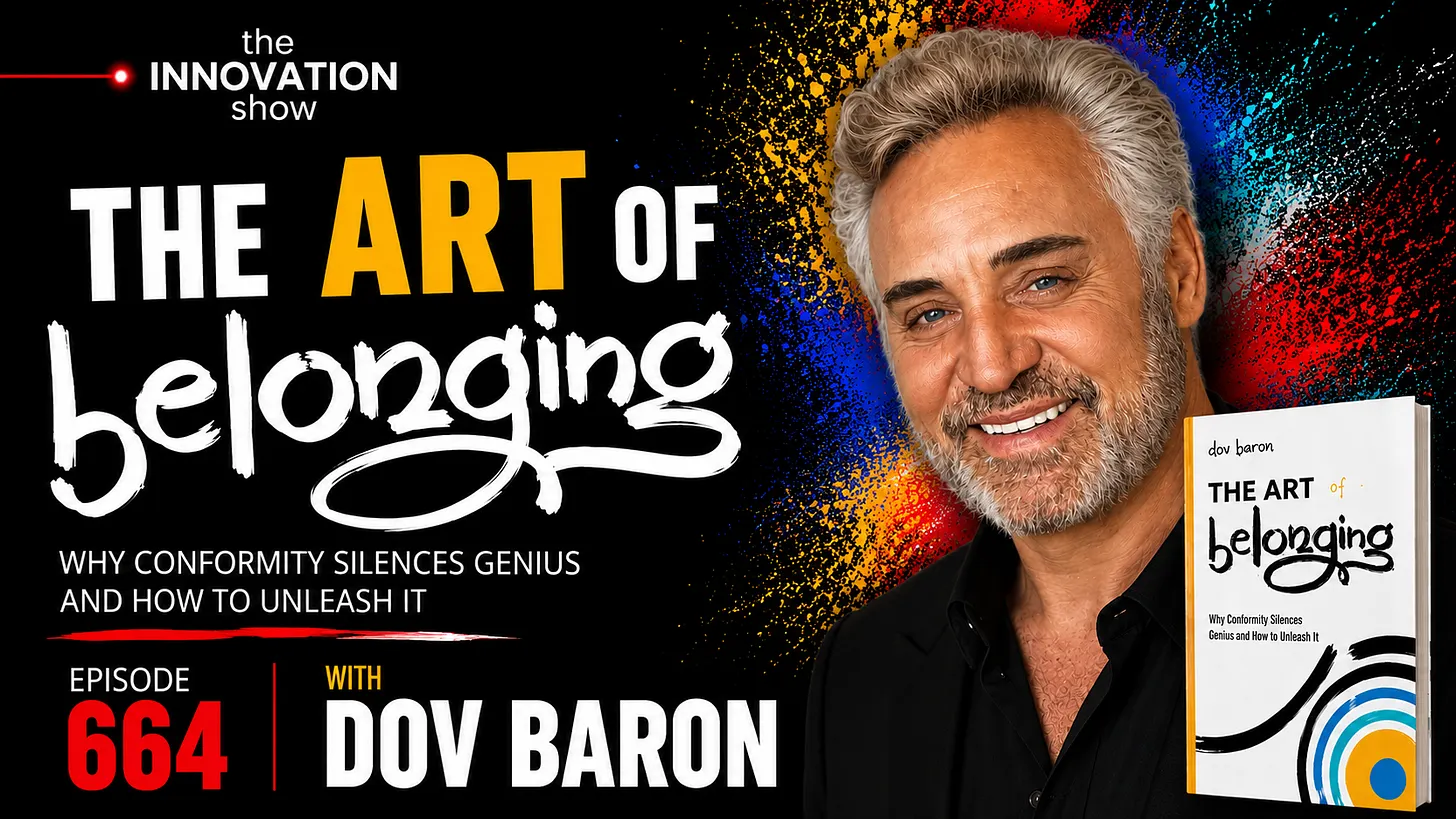
A note on where this piece came from. I first drafted it almost 5 years ago, but it jumped to mind fresh from two days of workshops in Vancouver. I shared the North Eastern Uni stage with Joe O'Connor, who cited the Microsoft research above. I also got to collaborate this week's guest, Dov Baron, whom I had the pleasure of interviewing in person. Dov's new book, The Art of Belonging, asks why conformity silences genius and how to unleash it, which is this piece's question wearing different clothes. The fast worker who learns to slow down is genius conforming. We were also joined by Chris Nelson and Shuo Chen, both of whom will join us on the show very soon.
Coming Thursday
And that episode with Efosa
and Gary Hamel
and Paul Nunes