
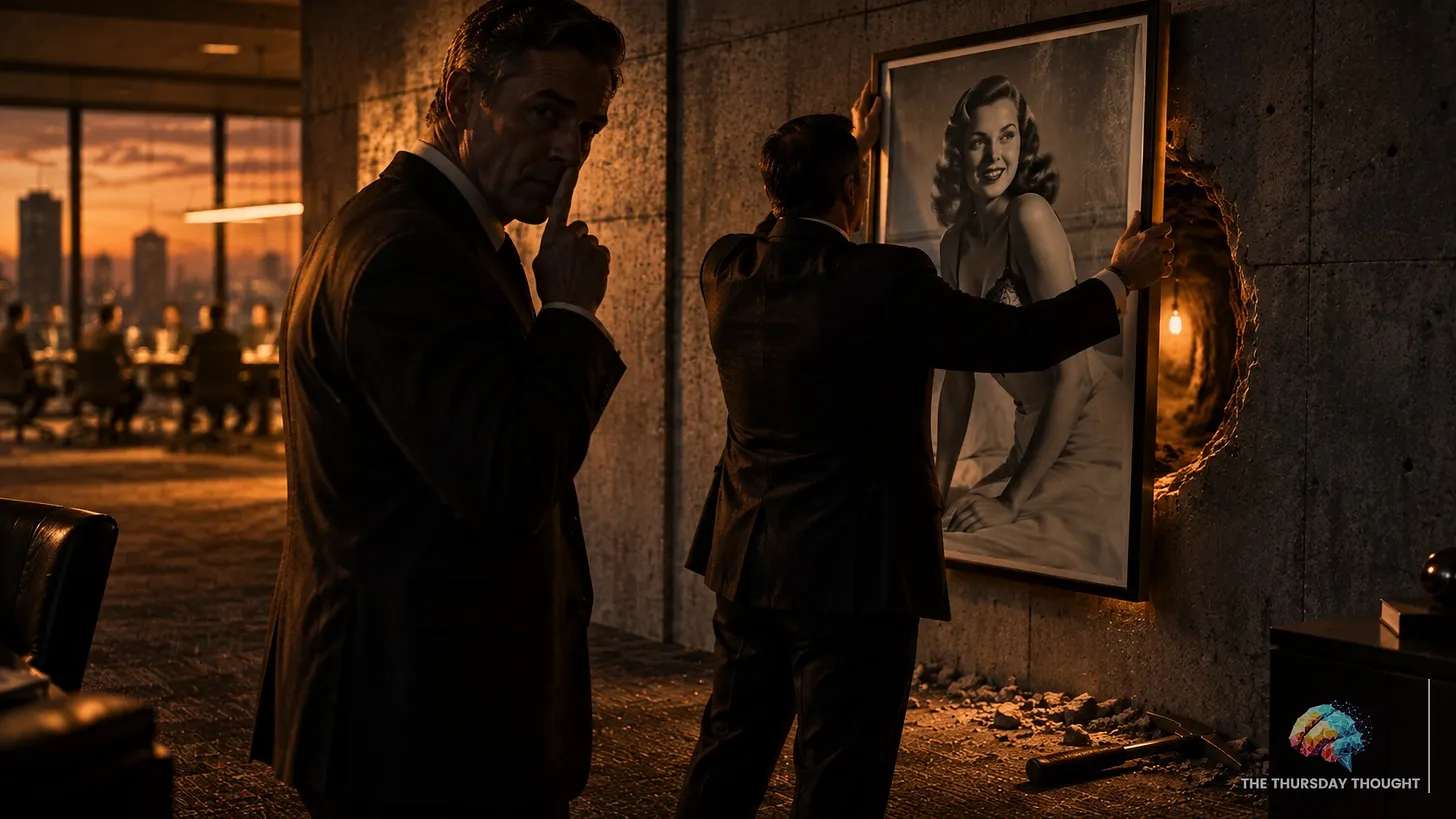
TL;DR: When a talented employee leaves to build the thing their employer would not, the organisation hangs a poster over the tunnel and claims "no longer a fit". Most of America's largest companies were founded by people who were still employed by somebody else. Some of those employers were offered the idea and said no. Most were never allowed to bloom at all. Either way, the incumbent held first refusal on the future and let it lapse. My guest on the current episode of The Innovation Show, Shuo Chen, calls the people behind this pattern fractional founders. Occasionally a leader backs the fugitive personally, and even then the value leaves with them.
“Intrapreneurs who surreptitiously yet successfully cross the boss now typically end up as external entrepreneurs.” — Michael Schrage, The Delicate Art of Unauthorized Innovation, HBR 2010
The Poster Over the Tunnel
When an intrapreneurial employee leaves a company to build something of their own, notice how the organisation speaks about them afterwards. The verdict is rarely a good one, and it doesn’t matter how much they gave the organisation. They’ll be labelled as difficult, negative, disgruntled, crazy even. Or perhaps they were never really a great fit. They had taken their eye off the day job or they had unrealistic ideas.
When I hear this, my mind always goes to the final act of The Shawshank Redemption, when the lead character Andy Dufresne escapes through the tunnel he spent nineteen years digging behind a poster on his cell wall, and hangs the poster back over the hole to hide what he has done. Companies often hang this poster themselves. Their badmouthing of the escapee serves a purpose. Nobody else must find the tunnel, nobody else should get the idea to leave, and the employees that stay must settle some cognitive dissonance that perhaps the organisation failed the person who fled.
What makes the organisational poster-hanging such an expensive act is what the tunnels turn out to have been worth, and how much the organisation could have made had it backed the fugitive.
Eight in Ten
“In the world, there are only 12 companies to ever be worth more than a trillion dollars. Two of them are non-American, 10 of them are American. The 10 American trillion-dollar companies, eight out of the 10 of them were all started fractionally.” — Shuo Chen, IOVC, on The Innovation Show
The term “started fractionally” means the founder had a job somewhere else while the company was being born. Their new venture was directly linked to the work they were already doing, and substantial portions of it were built before the founder handed in their resignation. Shuo’s research extends to the Fortune 500, where one in four companies began the same way.
On The Innovation Show, Shuo gave the example of Jensen Huang. He and his two co-founders were working full time in the semiconductor industry, steeped in its pain points, and met after work to ask how a chip company might be built better, faster and cheaper in every way. By the time they quit to make Nvidia their full-time job, much of the thinking was already done.
Shuo uses this research to combat the flawed concept that a part-time founder is less serious than a mythical founder who quits the day job and leaps into the unknown. Employers should find this trend uncomfortable, because every fractional founder once had an employer. For years, their ideas that in some cases became trillion-dollar companies gestated inside someone’s day job without anyone in the building batting an eyelid. If that is truly the case, then the employer had first refusal on the future, but most never knew there was anything to refuse in the first place. Others heard the pitch and never answered it, sending its owner from meeting to meeting until the idea starved, a pattern I wrote about previously, the dreaded fractal no.
Some were shown the idea and turned it down anyway.
The Medal of No
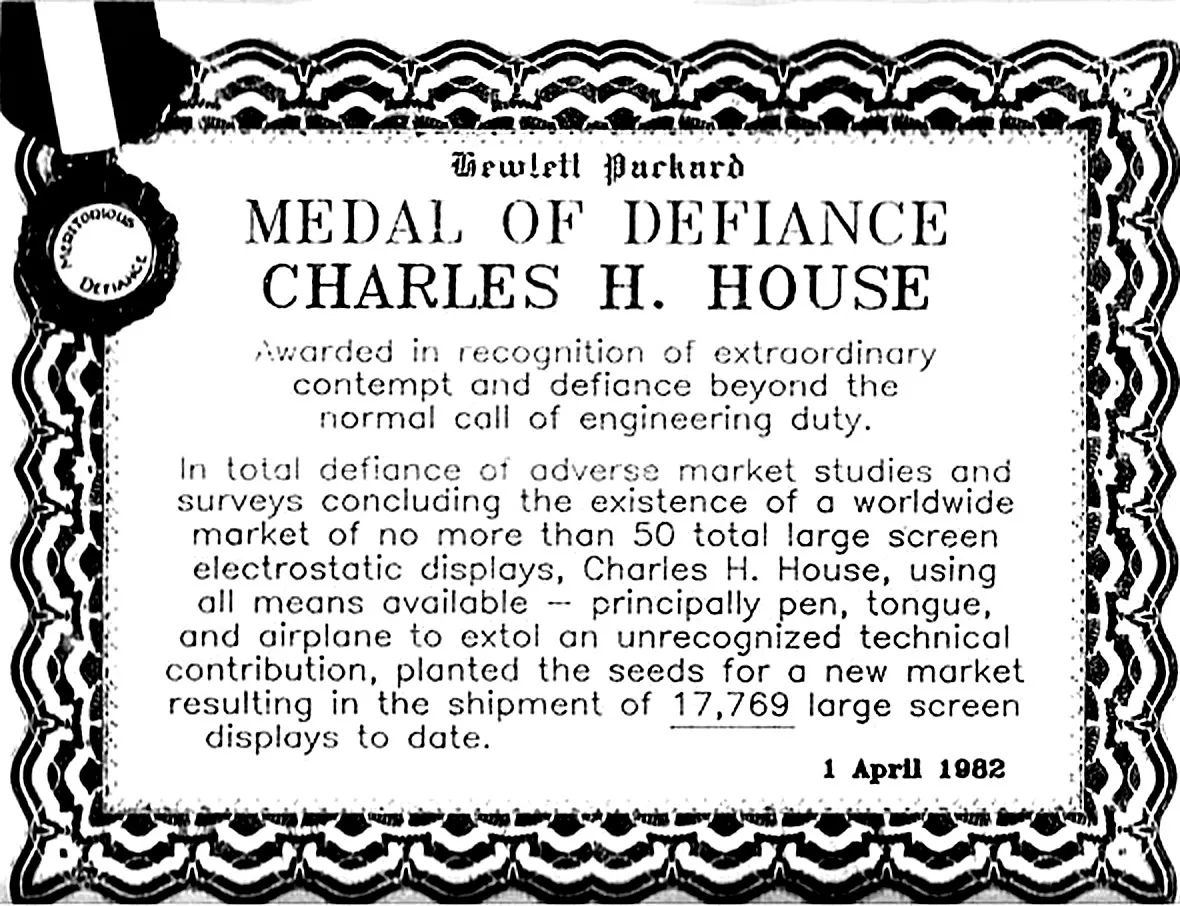
“Extraordinary contempt and defiance beyond the normal call of engineering duty.” — Hewlett-Packard, Medal of Defiance citation, 1982
In 1966, Hewlett-Packard engineer Chuck House refused to kill a project the HP co-founder David Packard had personally ordered killed. The project was a large-screen display. The internal market prognosis was a mere thirty-one units worldwide. After a site visit, Packard told House’s bosses that when he came back next year he did not want to see this project in the lab. When he heard the news, Chuck selectively interpreted the words to suit his ambition. He moved the project out of the lab and into production. When Packard returned a year later, he pounded the table and bellowed “I thought I said to kill this damn thing.” House replied: “No, sir. You said when you came back, you didn’t want to see this in the lab. It isn’t. It’s in production.”
The answer was not well received.
That same defied display went on to be used in pioneering heart surgery and as the prototype display for computing pioneer Alan Kay’s first personal computer. The prohibited product won a Hollywood technical Oscar. Better still, on the 20th of July, 1969, it produced the live television image of Neil Armstrong’s one giant leap for mankind on the surface of the moon. Against an internal forecast of a mere thirty-one units, it shipped almost 18,000.
Some 16 years after the row in the lab, in 1982, HP awarded Chuck the Medal of Defiance, and the citation reads “awarded in recognition of extraordinary contempt and defiance beyond the normal call of engineering duty.” Chuck thought the plaque was a joke, set it on a shelf in his new Palo Alto office, and a few weeks later threw it in the bin. When David Packard published his autobiography, he included the story of the medal and Chuck realised the award had been real. In his book, Packard called out the challenge to leaders, asking what one does with someone who is insubordinate when it turns out they were right.
Ten years after Chuck deviated from his directive, another young HP engineer designed a personal computer. This engineer was Steve Wozniak. “I was still planning on working at HP forever,” he writes in his memoir iWoz. He meant it. When he demoed one of his homemade games at Atari, where his friend Steve Jobs worked, Atari’s top engineers offered him a job on the spot. Wozniak refused, telling them he could never leave Hewlett-Packard, the best company there was for an engineer like him. Under the terms of his work contract, any IP developed during his employment belonged to the company. He built the machine at his cubicle in HP. On a typical evening he drove home after work, ate a TV dinner or made spaghetti, then drove the five minutes back, signed in again, and worked late into the night, because HP had all the test equipment and it was the kind of engineering environment he liked. The company’s own sign-in sheets recorded the Apple I being born. Before any partnership with Jobs was even inked, he told Jobs the design belonged to HP, and it did not matter to him whether that upset his friend. Offering it was the right and the ethical thing, and he genuinely believed this was a product HP should make. His managers had first refusal, heard the pitch and turned it down on the grounds that the division had neither the people nor the money to do anything with it (a common refrain for intrapreneurs and fractional founders alike).
Even when the first computer orders arrived, Wozniak ran it past HP one last time. This time the legal department circulated the design to every division before sending him a note disclaiming any right to his design. Released on paper, he founded Apple with Jobs. HP’s refusal became the best-publicised of a whole genre of first refusal stories, the enterprising employee with a good idea turned down and gone.
Within a decade, HP produced both the most celebrated act of internal defiance and the most expensive act of internal refusal in corporate history.
The two outcomes came down to one thing. While House had a founder willing to be crossed, Wozniak faced a process unwilling to deviate.
This refusal reflex has a gentler version. Fractional founders are not always met with a fractal no.
I’ll Hold Your Desk
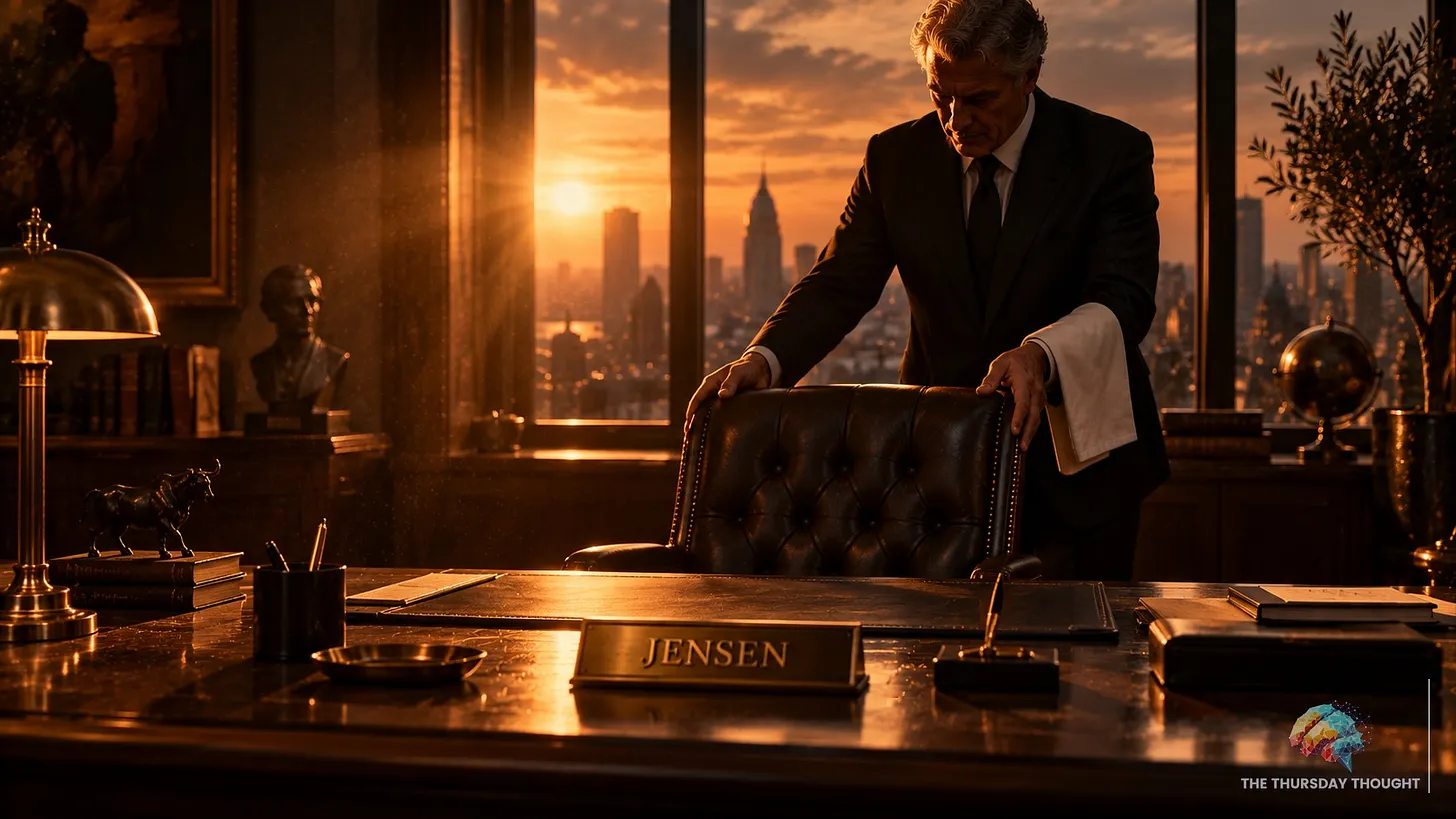
When Jensen Huang resigned from LSI Logic, as Tae Kim records in The Nvidia Way, his manager marched him straight to the chief executive, Wilf Corrigan, to be talked out of it. Corrigan listened to the vision for a new generation of graphics chips, asked whether he could invest in it personally, and told the departing engineer, “I’ll hold your desk.” Then he phoned Don Valentine at Sequoia and pitched him Huang the man rather than Nvidia the plan. The warden not only blessed the tunnel, he introduced the fugitive to the getaway driver. The problem was that LSI had no way to invest in Jensen as a company, but its chief executive could as an individual. Corrigan could back Huang with his own money. LSI could not back him at all. Sequoia got Nvidia. LSI got Rita Hayworth.
Our guest on the show, Shuo Chen, witnesses this culture of goodwill spreading, and shared the example of Marc Benioff, who conceived Salesforce while working at Oracle. His idea would serve customers Oracle was underserving. When Benioff finally left to build it, Larry Ellison did not read him the riot act, he wrote him a cheque.
First Refusal
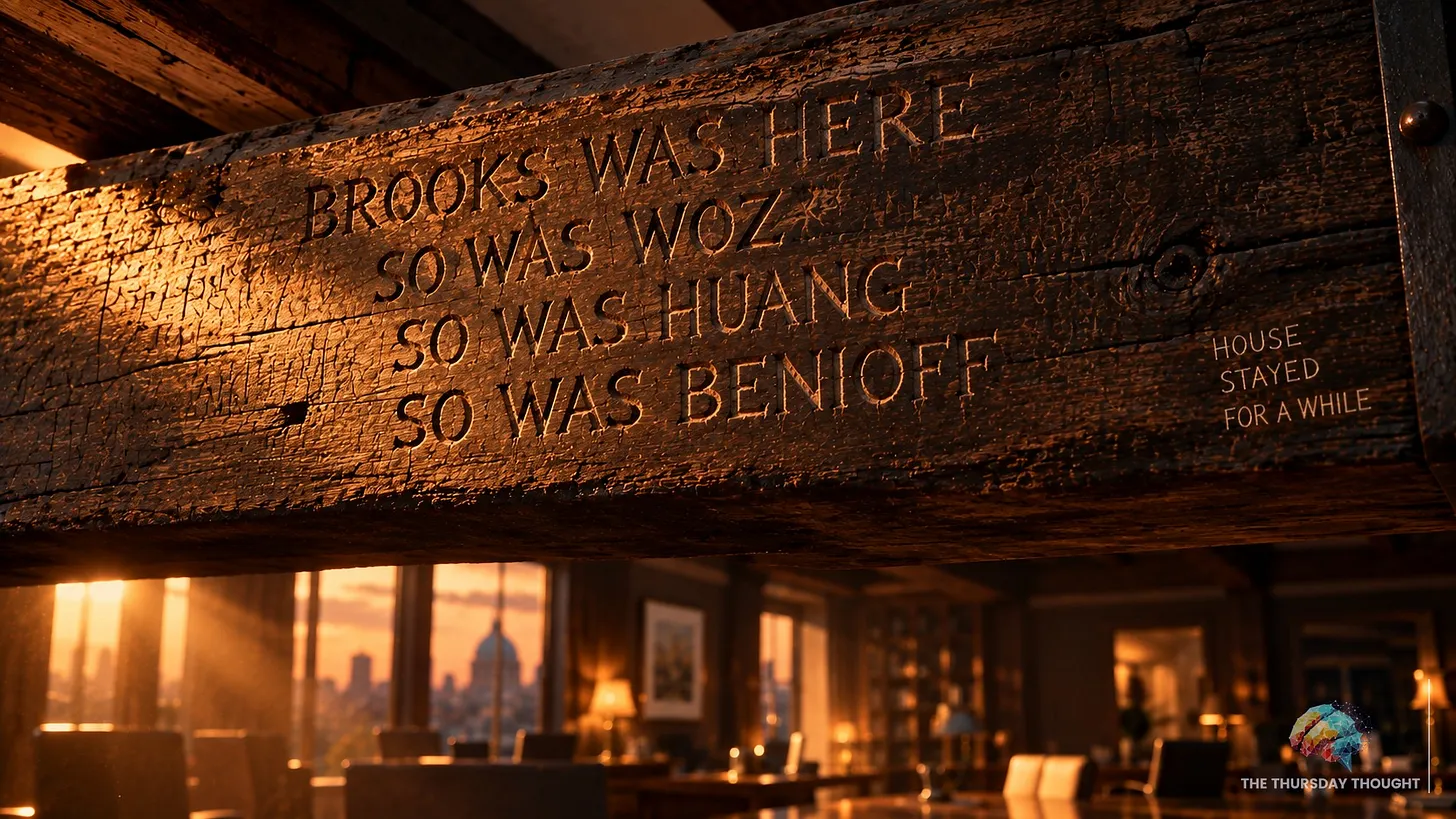
The walls of corporate America are covered in carvings nobody sees. Wozniak was here. Huang was here. So was Benioff.
Chuck House got a medal because David Packard was the kind of founder who could be defied with reluctant grace. Wilf Corrigan and Larry Ellison showed goodwill of their own. The founder wins, the investors win, but the company rarely changes anyhing, so the next idea leaves through the same tunnel. There are some exceptions that kept the value inside, Elliot Berman got his yes from Exxon in 1969, but exceptions depend on a sponsor’s discretion.
None of these stories shares how a company can make the yes structural. There is one that took the first refusal reflex so seriously enough they built an org structure to change it.It removed the managerial power to say no, and it turned its employees’ tunnels into ventures it part-owns, but that is a story for another Thursday Thought.
Or come and hear it from the source. At the forthcoming Thinkers50 Gala in London, I will have the honour of interviewing Zhang Ruimin, Chairman Emeritus of Haier Group and the man who built that company.
Epilogue
The Innovation Show is itself a fractional founding. I built it around my day job, at an organisation I left, and near the end I was given an ultimatum to stop the podcast, and stop The Thursday Thought. That was ten years ago, almost to the month. To everyone who has read along across those ten years, thank you. You are the reason the tunnel went somewhere.
This week on The Innovation Show
The companion episode to this essay is my conversation with Shuo Chen, general partner at IOVC and professor of entrepreneurship at Stanford and Berkeley. We go deeper on the fractional founders research, the Benioff cheque, Jensen Huang’s after-hours Nvidia, and what she tells the employers who keep losing these people.
By happy accident this is episode 666 of the show, a number that lands very differently in Chinese, where six sounds like the word for smooth and typing 666 is how you tell someone they have played a blinder. When I told Shuo her episode number, she was delighted with the good tidings. Find The Innovation Show on Apple Podcasts, Spotify and YouTube.