

TL;DR: Eight qualified coaches watched a fifteen-year-old Simon Kjær for six months, and none of them believed he had a future in soccer. Organisations misjudge young ideas the same way the coaches misjudged young talent, and they judge them harsher still when the idea sits next to a business that already pays the bills.
“The single-frame picture of a caterpillar does not foretell its transformation into a butterfly.”
R. Buckminster Fuller, “Planetary Planning”, The American Scholar, 1970
The Envelope: He hasn’t made a mark and he never will

In 2004 FC Midtjylland opened Scandinavia’s first soccer academy, in western Denmark. The bigger clubs had already taken the best boys, and the academy was one place short when a fifteen-year-old from a town 50 kilometres away came up for discussion. Every coach who had seen Simon Kjær play, Rasmus Ankersen among them, had reached the same conclusion. “He hasn’t made a mark and he never will.” They took him anyway, partly because his father was the academy’s kit man and they were keen to keep him happy.
Six months later the academy director gave each of the eight coaches a slip of paper and asked them to name the five players they thought most likely to go furthest. He sealed the slips in an envelope and put it in a drawer. Five years later Kjær was sold to Palermo for £3.3 million. When the envelope was opened, not one of the eight had written his name.
Kjær went on to captain Denmark. When Rasmus joined us on the show, he told me the player at the top of his own list had long since given up the game. “He runs a pizza place in the southern Denmark.” Knowing what he knows now, would he have picked Kjær? He’d like to think so, “but I’m not sure.” Talent spotting, as he sees it, is “about being less and less wrong.”
One Frame
The eight coaches made a perfectly understandable and common mistake, one the great Buckminster Fuller identified three decades earlier. A single frame of film showing a caterpillar, he wrote, does not foretell the butterfly.
The components of the butterfly are there, only latent. I recently joined Michael Bungay Stanier, a previous guest on the show, for his podcast Change Signal, and it didn’t take me long to get onto metamorphosis. While writing Undisruptable I spent a long time with the biology of the butterfly and its imaginal discs, named for the imago, the adult form they will one day build. Before a caterpillar even hatches, it grows a small cluster of cells for each adult body part it will need, and in the chrysalis those clusters survive while the rest of the caterpillar dissolves in a beautiful act of creative destruction. Everything the butterfly needs is present from the start, and a freeze frame reveals none of it.
Each of those lists in the envelope was a freeze frame, taken by a coach who had paused the film a mere six months in.
Puny

“What is a weed? A plant whose virtues have not yet been discovered.” - Ralph Waldo Emerson, Fortune of the Republic, 1878
Everyone has their own version of the Simon Kjær problem, and companies suffer from a much harsher version. A young player is at least judged against boys his own age (or so you’d hope). A new idea inside an established company is judged against the mature business that pays everyone’s salary. Worse still, the judge is usually someone whose past calls built that business, and a track record like that is very hard to argue with.
Peter Drucker argued in Innovation and Entrepreneurship that the obstacle to innovation is the existing operation itself, whose daily crises always come first, and that beside it the new looks “so small, so puny, so unpromising.”
In the mid-1990s, Intel senior executive Frank Gill had built a networking business inside the company. He recalled Andy Grove telling him that even at a billion dollars in revenue, with normal profits, this fledgling business would only earn about $25 million a quarter. Intel’s microprocessors were making a billion a quarter, which is Drucker’s puny line in the field. Networking stayed on the edge of the company for years, and by the time Gill’s successor tied it to the microprocessor business, Cisco had won the market.
Grove, meanwhile, poured far more money into videoconferencing, which the market didn’t yet want. To his credit he later conceded that Intel had once considered, halfheartedly, buying Cisco when it was a $200 million company.
A few years earlier, the same eye had made a call that looked far better at the time. Intel’s leaders discovered that one of their engineers was building a chip on RISC, a simpler design several rivals were backing, and a direct challenge to the x86 chips Intel’s biggest customers had built their computers around. Inside Intel it was nicknamed a YARP, yet another RISC processor. Grove judged it better on some counts but not by enough to make customers switch, and he disbanded the team, drawing the lesson that “not all paradigm shifts are paradigm shifts.”
Decades later, RISC became the architecture ARM put inside the world’s phones, and Intel missed it. Robert Burgelman and I have just recorded this week’s episode of the show, and he told me the right call always looks obvious in hindsight, “but it is not at the time that you have to make the decisions.” By 1999, Grove could see that the same rigour that killed RISC had starved networking. “I weed out all the weeds,” he told Burgelman, “but also some of the potential seeds.”
The Coach Who Got It Wrong

“My keynotes start with me getting it wrong and end with me getting it wrong.” - David Bland
On last week's Innovation Show, David Bland told me about a workshop he once ran for an ABC Family reality series about young founders testing early ideas. One of them wanted to build a new kind of kitty litter. "There's a million brands of kitty litter," he remembered thinking. "Like how is this possibly different?" The founder started PrettyLitter from his apartment after the show, and six years later Mars bought it for a price reported at up to $1 billion. Had Bland been one of the eight coaches, he would have left Kjær off his list along with the rest of them.
“A good idea and a bad idea look very similar early on,” he said, so he stopped giving verdicts on people’s ideas. “Who am I to say if your idea is good or bad? Let's run through the process and, and find out.” David learned the hard way, and he know lets the assumptions map do the judging.
The map, from Testing Business Ideas, is a two-by-two with importance on one axis. The other axis took three attempts. Bland first labelled it known and unknown, and teams told him “I just know.” He changed it to certain and uncertain, and they said they were certain because they just knew. The version that stuck asks one thing about every assumption, whether there is evidence for it, and “I just know” has nowhere to go.
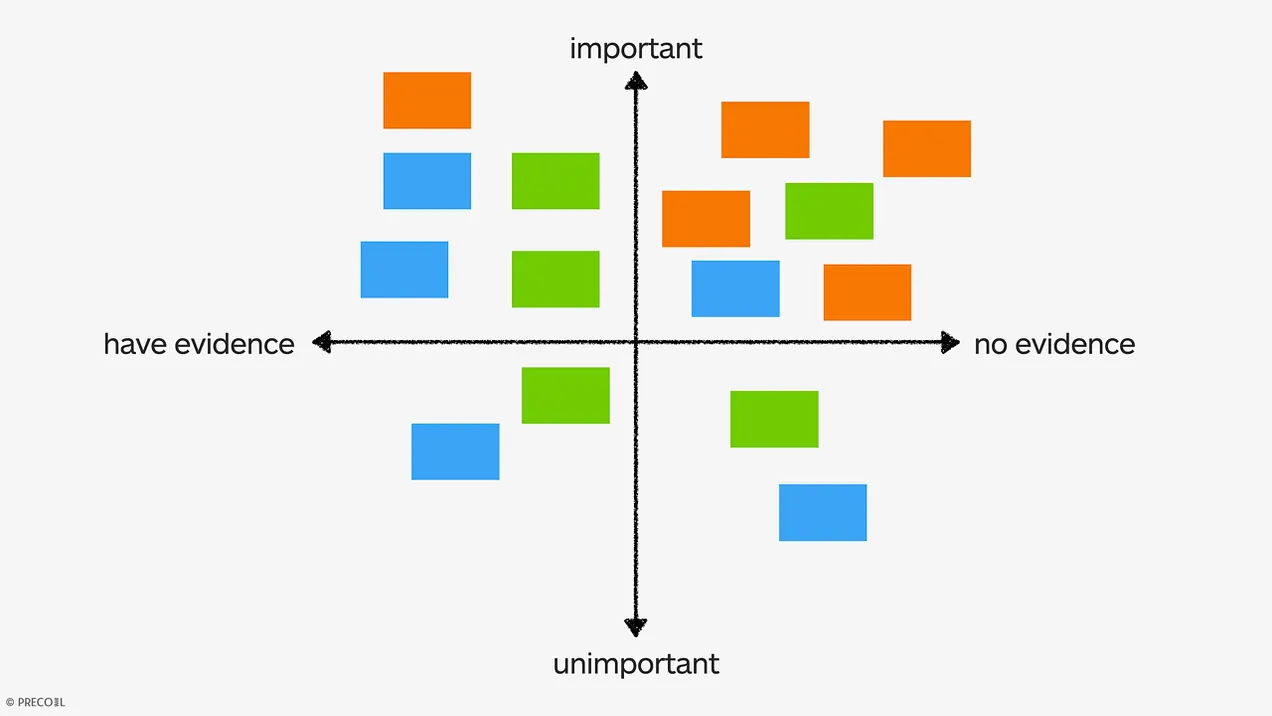
He also won’t let a leader facilitate the session, because nobody talks openly about the assumptions behind the boss’s idea. At DuPont, 35 multimillion dollar ideas went through the process. Stopping work on the ones that failed saved over $12 million, and the ones that passed have made about $24 million so far.
Unlike that academy, companies rarely write their early verdicts down, so neither the ideas they kill nor the ones they back leave a record, and the people who made those calls go on believing they have a good eye, because they just know. A sealed envelope costs nothing but accountability, and without one no judge ever gets less and less wrong.
On this week’s show we are joined by Robert Burgelman, professor at Stanford Graduate School of Business and author of Strategy is Destiny, who has spent decades studying how Intel decided what to back and what to kill. His new paper with Sasanka Sekhar Chanda revisits three of those decisions, from the move out of memory chips into microprocessors to the RISC chip Andy Grove shut down and the networking business he never fully backed, and asks what separated the seeds from the weeds. Robert’s answer is that leaders keep backing a project when it teaches the company something it didn’t already know. We also get into Intel’s nickname for RISC, why Grove had no patience for statements that were somewhat right but mostly wrong, and the people map one Nike executive drew to take the company into the women’s business.
Find The Innovation Show on Apple Podcasts, Spotify and YouTube.
That episode with Michael Bungay Stanier
Sources available for paid subscribers:
Sources with links
R. Buckminster Fuller, “Planetary Planning”, The American Scholar, 1970, via Quote Investigator
Rasmus Ankersen, The Gold Mine Effect, and on The Innovation Show (EP 149)
Aidan McCullen, Undisruptable, and on Change Signal with Michael Bungay Stanier
Ferris Jabr, “How Does a Caterpillar Turn into a Butterfly?”, Scientific American
Ralph Waldo Emerson, “Fortune of the Republic”, lecture at the Old South Church, Boston, 1878
Robert A. Burgelman, Strategy is Destiny (2002), and with Sasanka Sekhar Chanda, “Autonomous strategic behavior, organizational learning and top management support”, Strategic Management Review, 2026
Crystal Tse and Kiel Porter, “Mars Is Said to Acquire PrettyLitter for Under $1 Billion”, Bloomberg, 2021
Bland and Osterwalder, Testing Business Ideas
Winner of Testing Business Ideas
The Winner of a Digital Copy is Rob T, a paid subscriber, Rob I will be in touch to send the book.