

TL;DR: Zugzwang is a chess position in which every conceivable move weakens you and the rules will not let you pass. IBM played corporate zugzwang through System/360, the most successful product in the company's history. However, the modular design rules that helped IBM succeed beyond their wildest dreams were the same rules that liberated their very own engineers to walk out the door and compete against "Big Blue" module by module, like death by a thousand cuts. IBM won every exchange that followed and still conceded the match. Modularising summons your competitors, and awareness is no defence, because seeing a trap and escaping it are separate problems. Carliss Baldwin, Kim Clark, and Rebecca Henderson described this trap before Clayton Christensen named the innovator's dilemma. Today, every organisation mapping its workflows for AI agents is playing a similar opening gambit.
“Remember, the game is never incontestably won.” — Bob Hayes, as recalled by Kim Clark on The Innovation Show
The Compulsion to Move

Zugzwang is a chess position where every move you can make weakens you, and the rules will not let you pass. Nothing is actually under attack. If you could leave the pieces still, everything would be just fine. But it is your move, and the clock is ticking, and any square you touch will just make things worse.
Zugzwang differs from the better-known fork position, where a knight lands on a square that attacks two pieces at once. A fork stings, but it leaves you with a choice. You give up the rook, keep the queen, and play on, collateral damage of war, business and chess. Zugzwang, however, gives you no such option. Every path leads downhill, and the game insists you pick a path.
Business has similar unwritten rules. And one of the most instructive cases of corporate zugzwang was not inflicted by a rival. IBM built the position itself, paradoxically through the most successful product in its history.
One difference between the board and the boardroom is worth carrying with us too. In chess the game can be incontestably won. Checkmate ends it, the pieces go back in the box, and the result stands forever. In real life, and in business, that is rarely the case. The market resets the board every morning and obliges everyone to play on, which is why Bob Hayes’s warning above is the line this story keeps returning to.
What Modularity Means

Imagine a burger joint, known for its relish. It began by buying relish in from a supplier. Once established, it brought relish making in house on the reasonable assumption that fresh would taste better and worth the higher cost. However, the customers decided for the owners. Customers reported the bought-in version as better, and when the owner looked into why, he found that the strength of the ingredients varied from batch to batch, thus so did the flavour. The fresh version was the less reliable one. So quite happily they went back to the original supplier. The relish became a part the business could buy in and slot into the burger, and nothing else about the burger had to change.
That is modularity in action. A design is modular when you can break a complex thing into component parts that connect through fixed, agreed rules, so that each part can be improved or swapped without rebuilding the whole thing.
Every modular design splits its information in two. The rules everyone must follow, what Carliss Baldwin and Kim Clark call the visible information, and the choices sealed inside each part, the hidden information, which nobody else needs to see.
For the burger joint, the visible rules were the tub size, the delivery day, the consistent taste the customers expected. How the supplier achieved that taste was their business, and that privacy is exactly where a supplier is free to experiment and to win in their own game. This is why Baldwin insists modularity is invented rather than evolved. Someone has to decide in advance which rules are fixed for all and which are left open.
For the burger place the bargain appears to be all gain. It was never going to build a relish empire, and the supplier is no threat to a burger joint, right?
That is the modularisation dilemma. IBM made an identical move in a different arena years before the burger joint, but for them the (relish) supplier became one of many competitors that all began to (ahem) eat their lunch. IBM made the move that paved the way, but the worst thing is, they didn’t have a choice but to play the new game.
The Move IBM Had to Make
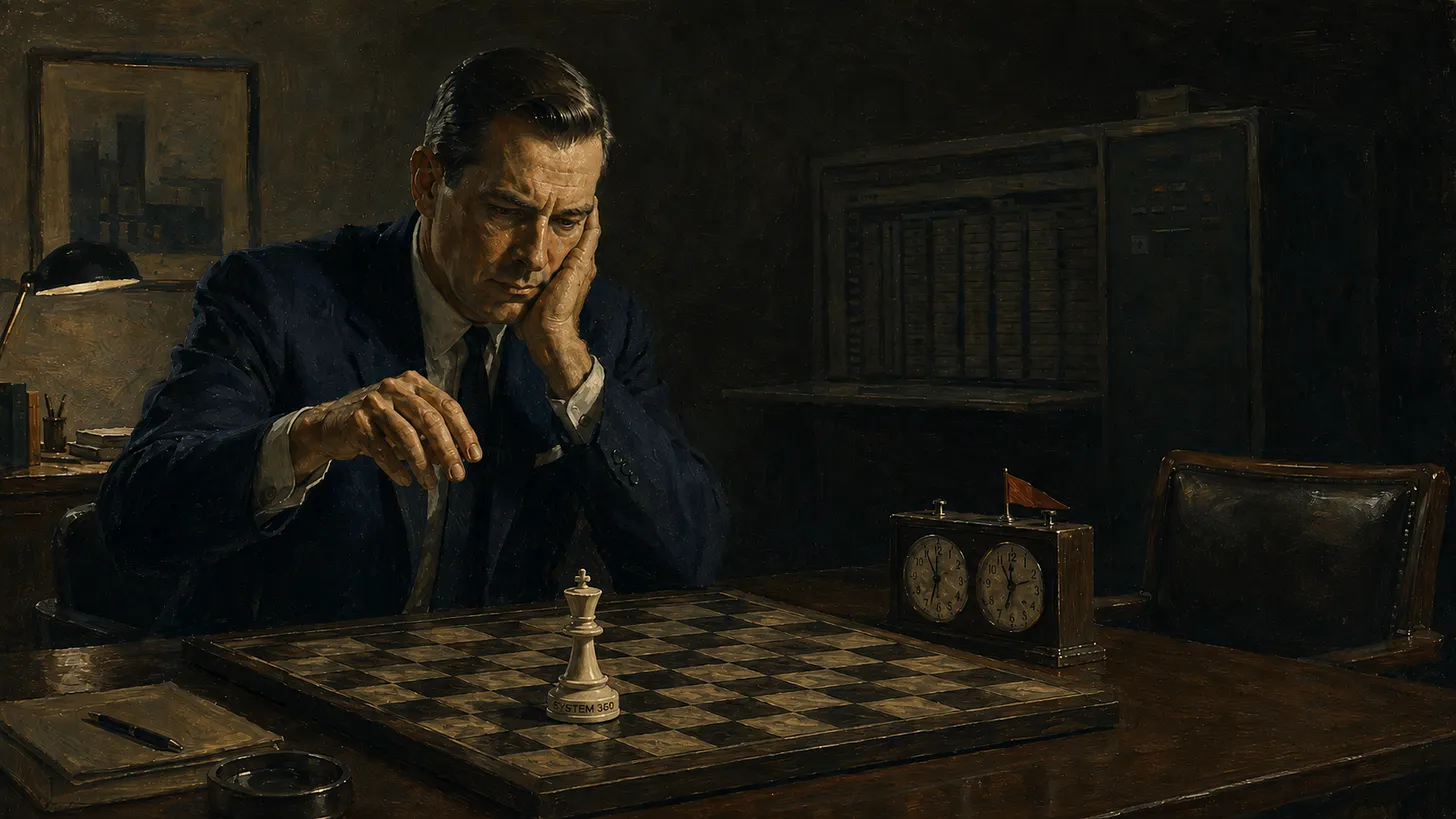
By the late 1950s, IBM’s computers had diverged into a number of incompatible product lines. Each machine was a whole-system product with its unique instruction set, its own peripherals, and its own software. Every upgrade forced customers to rewrite programs they had painstakingly built by hand. As Carliss Baldwin put it on The Innovation Show, customers did not want to rewrite their hard-won software just to buy the next bigger machine. This incompatibility problem was about to stop sales in their tracks and force customers to seek alternatives.
Despite its dominance, IBM was already in a position it could not hold. In late 1961 it convened a task group to plan the future of its processor products. The group’s report recommended replacing IBM’s entire product line with a single family of compatible machines, governed by a common set of “design rules”, if every processor and every peripheral obeyed these rules, software written for one machine would run on the next one up, and the next one after that.
Carliss argues that this was the first conscious exercise of a modular platform strategy, and she is emphatic that such a thing never happens by accident. Most ways of organising work grew up gradually, through centuries of trial and error. A modular system cannot evolve gradually, because the rules have to exist before the parts can be built. Someone has to write the rules down, in advance, and get them right. On the show she called this an invention, not an evolution.
In our chess analogy, IBM was in zugzwang. It had to move, and it knew the move would change the game forever.
The Best Move on the Board
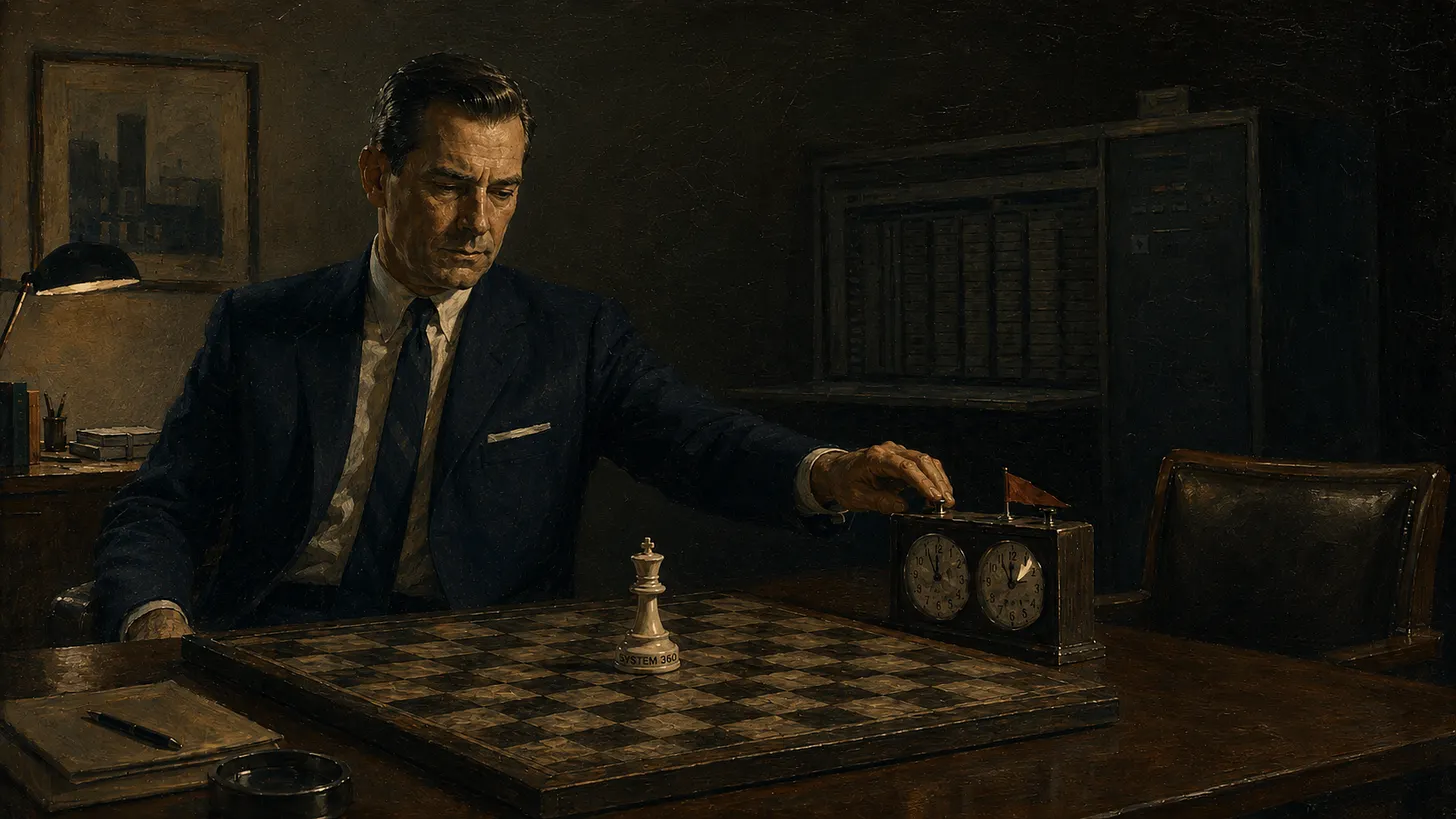
On 7 April 1964, in press conferences held simultaneously in 77 cities, IBM announced System/360, an entire family of machines, all bound by one new architecture. Delivery was at least a year away, yet customers ordered 1,100 machines in the first month. The gamble had sunk around $5 billion, some $20 billion in Baldwin and Clark's later reckoning. IBM had bet the company, but the bet paid off.
By 1970 the company’s revenues had grown to $7.5 billion, and System/360 as a whole was worth around $170 billion in the inflation-adjusted dollars of the mid-1990s. On The Innovation Show, Kim Clark recalled that IBM held something like 90% of all the value in the computer industry, and that within a few years of the announcement people had stopped describing IBM as a competitor at all. They simply said IBM was the environment.
It seemed like the game was incontestably won. Except the game is never over, because the same design rules that made the family compatible were now published. Anyone who knew the architecture, the interfaces, the rules could build a module that plugged into IBM’s environment and chip away at their margin, as they occupied square after square on the board. The company had spent $5 billion writing the rules of the new game that anyone could now sit down and play.
Twelve Engineers and the Door
In December 1967, less than a year after the new modular structure became a working reality, 12 employees left IBM’s San Jose lab, the home of its disk drive research, to found a company called Information Storage Systems. IBM dubbed them the dirty dozen, because they left with the latest state-of-the-art knowledge of drive design, and the System/360’s design rules. They immediately struck a deal to supply drives to Telex, one of several firms already announcing IBM-compatible products, and within 6 months they had produced an IBM-compatible drive that was faster and cheaper than IBM's version.
These drives were the first of many. Experienced designers left for the makers of what the industry came to call plug-compatible peripherals, and those firms launched superior products at lower prices, often building concepts that had been sitting in IBM’s own research centres. By early 1970 the plug-compatible makers had taken 11% of the tape drive market and 4% of disk drives, and their installations were soon growing at around 20% a month.
It is important to remember that nobody attacked IBM. It was IBM’s own move that allowed the attackers onto the board.
Zugzwang

“Corporations are expendable and... success—at best—is an impermanent achievement which can always slip out of hand." - Thomas J. Watson Jr., A Business and Its Beliefs, published one year before the System/360 announcement.
There is one of the classical Chinese thirty-six war stratagems, called shut the door to catch the thief. You seal the exits, trap your enemy inside, and finish the battle on your terms. IBM had almost executed this stratagem, they did shut the door, only to discover that it had sealed itself into the room along with every competitor its very own design rules had created, and now nobody could leave.
From 1970, IBM began to move, and every move conceded something.
When IBM cut the price of its newest disk drive by 46%, the plug-compatible makers matched the discount and kept growing. Next IBM rewrote its own interfaces, reversing the compatibility promise that was the entire point of System/360. Then Big Blue locked customers into long leases with heavy cancellation penalties, and attackers’ earnings began to shrink. It bundled memory back into the processor, unmodularising what it had just modularised. Lawsuits littered the board, and the US Department of Justice, which had filed its antitrust case in 1969, dragged through the courts for 13 years.
Tactically, IBM won almost everything. The courts rejected most of the monopoly complaints, and Baldwin and Clark’s verdict is that by the early 1980s the plug-compatible makers “only existed on the sufferance of IBM.” But each winning move exacted a cost. Cutting prices dismantled the margin structure that had funded everything else. Holding prices high would have protected the attackers. Changing interfaces spent the trust of customers who had bought the promise of compatibility.
And no move on the board could bring back the hundreds of hidden-module designers (in Baldwin and Clark's architectural parlance) who had left. By 1980, the most advanced designers of disk drives, tape drives, memory, processors, and software often no longer worked for IBM. The company had lost control of where the designs themselves were going.
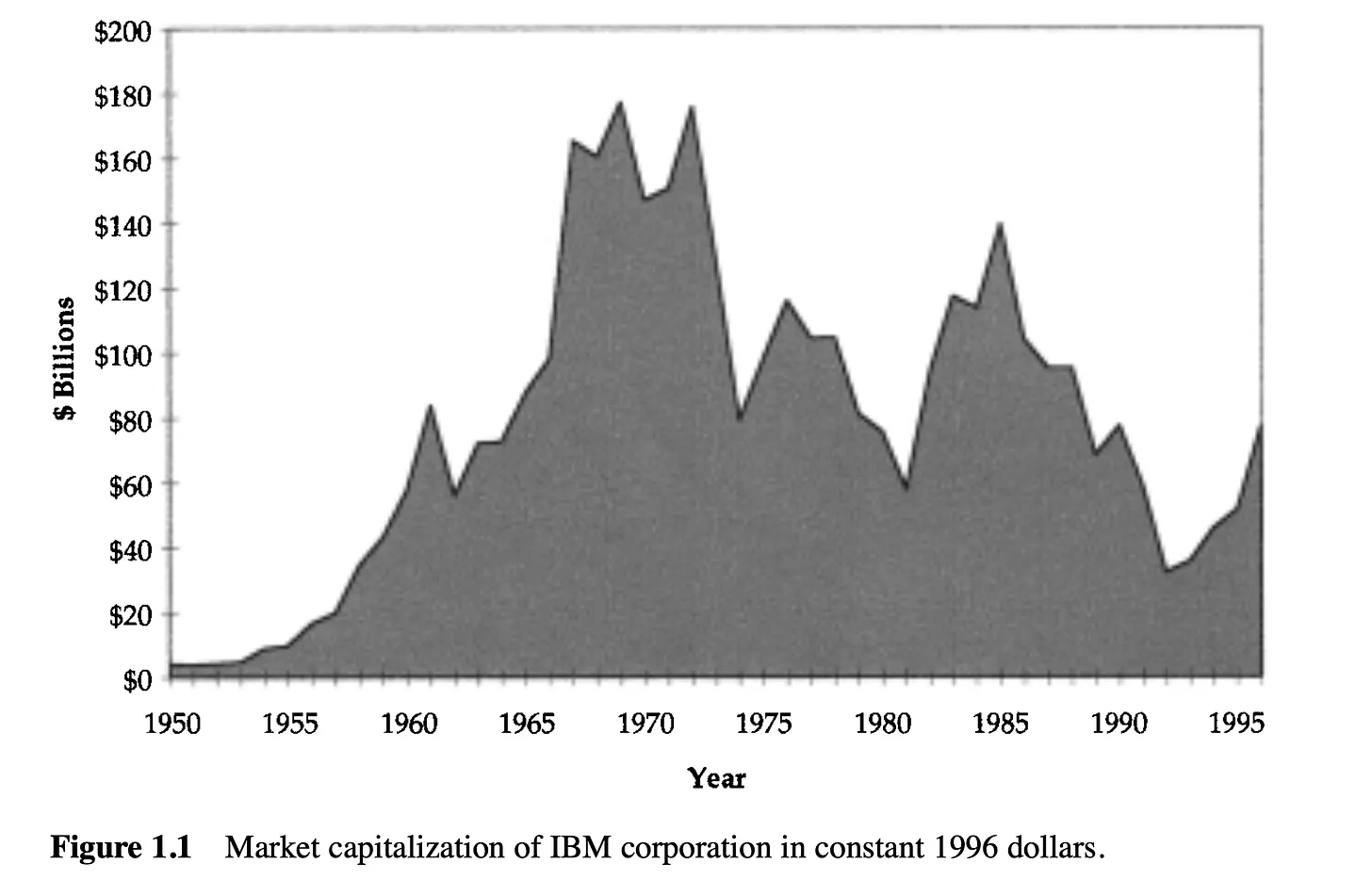
The capital markets kept a running score of the game, now a historical record that we can learn from. See Figure 1.1 above from Baldwin and Clark’s Design Rules. IBM’s market value dropped in 1973 and never again reached its inflation-adjusted highs. It remained dominant for another two decades, still holding roughly 35% of the industry’s market value as late as 1990, and then the mainframe business collapsed between 1991 and 1993.
In 1995, Microsoft passed IBM in market value for the first time (a player IBM enabled to join the game). An industry that had been a virtual monopoly became a cluster of more than 1,000 publicly traded firms, most of them making the hidden modules of other people’s systems.
Two of IBM’s moves during that long middle game deserve a mention. Kim Clark told these stories on The Innovation Show. IBM once owned 30% of Intel. And when IBM contracted a tiny company called Microsoft to build the operating system for its personal computer, it did not stipulate in that contract who owned the operating system. The processor and the operating system became the only two positions on the new board that generated durable profit, and IBM had hovered its hand over both moves and decided to set them down.
The Modularisation Dilemma

“Your history constrains you a lot.” — Carliss Baldwin, The Innovation Show
We know the innovator's dilemma published by Clayton Christensen in 1997. Incumbents fail because they actively listen to their best customers, they allocate resources to whatever those customers demand, and they dismiss the inferior-looking technology coming from below. It is a trap that the market springs on you. Christensen found one theme common to every failure he studied. The fatal decisions were made while those making them were "widely regarded as among the best companies in the world." These were not stupid people, in some cases they were in zugzwang, in others they just did what was best for their customers and in others still they did indeed do what they thought was best for themselves.
The trap described here is a cousin of that dilemma, maybe even a parent. Christensen built on this foundational work. Rebecca Henderson and Kim Clark had published their paper on architectural innovation and the failure of established firms in 1990, Baldwin and Clark spent the following decade formulating Design Rules in 2000. Christensen, their Harvard colleague and beloved friend, drew on that work.
Perhaps the reason the modularisation dilemma is less famous is that the idea is genuinely hard to get your head around, indeed it is what I am struggling through with my writing. Kim Clark helped me with a distinction on the show. In Christensen’s world, incumbents underinvest in the new thing. In the architectural world, incumbents see the threat clearly, allocate the resources, and build the new proactive product or service, and it still fails, because the nuances live in connections (tacit rules) they never knew existed.
The modularisation dilemma is a trap you spring on yourself. Splitting your product into modules is what lets you manage complexity, work in parallel, and scale into an environment rather than remaining a mere company. It is frequently the best move on any board, but taking the shot publishes the map of your business, module by module, for everyone capable of supplying a module. It is as if the Relish maker’s recipe becomes public knowledge and the burger joint no longer needs them or worse, the relish maker decides to move upstream and open a chain of burger joints.
The act of modularising your product is the very act that summons your future competitors into existence and onto the board. After that, every defensive move costs you something, skipping your turn is not an option and the sands of time keep running.
Sangeet Paul Choudary , recently on the Innovation Show alongside Rita McGrath, offered the question a company should ask before outsourcing any capability, “if I outsource this, will I enable the creation of capabilities outside (my firm)?”
It is a vital question, but here is the tragedy, IBM didn’t outsource anything, instead they published the design rules, because the tacit rules were the capability.
In 1963, the year before the announcement, Thomas J. Watson Jr. published A Business and Its Beliefs, and in it he warned that success is an impermanent thing. The chairman had the warning in print, in his own hand, 12 months before he bet the company, and figure 1.1 above shows his sentence coming true on the scale of an industry.
Awareness was never the missing ingredient for IBM. Seeing the trap and escaping it are separate problems.
Nobody forced IBM to design System/360. But its old product lines were already losing customers, and standing still was itself a losing play, so the real choice was to modularise and invite the competition in, or refuse to change and lose sales straight away. That is the real snag of the modularisation dilemma. The move that walks you into zugzwang looks like one you make freely, it is more akin to jumping from a sinking ship to save your life, you still have a lot of work to do and the odds are not necessarily stacked in your favour. But standing still is not one of the squares on the board.
The Same Opening, Replayed in an Age of AI
Carliss Baldwin told us she sees the same board being set up again. Companies rushing to deploy AI agents are discovering that agents are modules, and modules need design rules. So organisations that never had cause to map the tasks and transfers inside their divisions and teams are now mapping their workflows, because the AI demands it. Every workflow map is a draft set of design rules. And the lesson of 1967’s dirty dozen departure is that once the rules exist in transferable form, they do not stay inside the building.
Recent Innovation Show guest Usman Sheikh, looking at the AI shift from the vantage of professional services, said, “Some will change shape. Few will keep the gain.”
IBM played the best move in the history of its industry and then spent the next 30 years in zugzwang.
Perhaps the real lesson is to make the move knowing exactly the squares it will open on the board, for you and for everyone else, because the game is never incontestably won.
On This Week’s Innovation Show, drops Thursday August 20th 2026

Alexander Osterwalder returns for Part 2 of our Strategyzer series, on value proposition design in an age of AI. Generative AI can formulate a brilliant value proposition, but only if you have done the homework it cannot do for you: validated customer jobs, pains, and gains, benefits backed by evidence, and differentiation your customers actually care about. It is a fitting companion to this week’s piece, because the homework is your hidden information, and the formulation is only the visible layer. Alex also demonstrates Strategyzer’s new Value Stack tool and argues that growth is a profession, not a creative gift.
Sign up for the Kyndryl Institute at kyndryl.com/institute and send us a screenshot of your sign-up for a chance to win a copy of Value Proposition Design, with thanks to Kyndryl.
Alex has also kindly given our audience 20% off any Strategyzer’s playbook just by using the coupon code INNOVATIONSHOW20.