

A newly released 2026 study in Science found that from midlife onward, the brain’s original immune cells, formed in the womb, are progressively replaced by more inflammatory cells. These new cells overreact in the brain, detecting risks in everything.
In this Thursday Thought, I use this new study as a metaphor for how organisations age the same way. The founding temperament is replaced by an inflammatory one that registers deviation as threat.
We have all heard the terms corporate immune system and corporate antibodies, usually offered as loose metaphor. It turns out the science backs them up. I draw on some writers who mapped corporate decline decades ago. They recorded the decline in the language of persecution and exile, while this new research supplies the biological foundation to support their metaphors.
The way out of such decline seems to be the same for the organisation as for the brain. Rejection is the system’s default, an inflammatory response, but tolerance can be acquired in the human and organisational brain alike.
“The mind likes a strange idea as little as the body likes a strange protein, and resists it with a similar energy. It would not perhaps be too fanciful to say that a new idea is the most quickly acting antigen known to science. If we watch ourselves honestly we shall often find that we have begun to argue against a new idea even before it has been completely stated.” - Wilfred Trotter, *The Collected Papers of Wilfred Trotter* (1941)
A Changing of the Guard

For almost a century, neuroscientists believed the brain's immune cells stayed with us for life. These cells, called microglia, are the central nervous system's defence force, constantly patrolling the brain and spinal cord, clearing cellular waste, and responding to damage and infection. They form in utero, and the assumption was that this founding population of cells renewed itself. We assumed it was the same lineage keeping watch over the same mind until death.
In July 2026, a study of the human hippocampus by N. R. Zemke et al. overturned that assumption. Zemke and his colleagues examined brain tissue from forty neurologically healthy adults aged 20 to 95, reading each cell on two levels. First, what it was doing day to day, and second, where it had come from. What they discovered was a phase change: from roughly age 50, the original microglia (cells) start to leave. What takes their place looks, at first glance, like just more microglia, the newly arriving cells keeping watch over the old mind. These cells responded to damage like their predecessors and passed every behavioural inspection. Only their ancestry gave them away. Cells inherit a pattern of chemical tags the way a family passes down a surname, and the newcomers’ surname was wrong: their tags resembled those of immune cells that circulate in the blood, and they displayed all the hallmarks of proinflammatory cells.
All this happens in the hippocampus, the brain’s centre of learning and memory (for regular readers of this newsletter, that is the area that changed in the London taxi driver study). The organ of remembering is precisely where the guard changes. In a proper changing of the guard, the outgoing sentry briefs the incoming one and information is passed on. Here the post changes hands with no handover at all, which is why nobody noticed for a century.
Any leader who has stayed with an organisation through its own midlife will recognise the same pattern. Only now do we have neuroscience to match the organisational process.
Salem City

“Organizations, by their very nature, are designed to promote order and routine; they are inhospitable environments for innovation.” — Theodore Levitt, “Creativity Is Not Enough”
In his 1989 book Barbarians to Bureaucrats, Lawrence Miller mapped the life of a corporation onto the rise and fall of civilisations. Companies, he argued, are founded by Prophets, who provide the vision, and Barbarians, who lead the conquest. Next, the Builders and Explorers develop the specialised skills of growth. Then, Administrators arrive to supply systems and security. Then comes the stage Miller considered fatal. The Bureaucrat imposes a tight grip of control and, in Miller’s arresting phrase, “crucifies and exiles” the next generation of prophets and barbarians. The founding temperament is expelled, and the organisation is backfilled by a population whose instinct is control. Eerily like what kickstarts the decline of the brain.
In his 2004 book Managing Corporate Lifecycles, Ichak Adizes called the equivalent stage a “witch trial”. In Salem City, the administrators not only outnumber the intrapreneurs; they expel and imprison them. Whoever remains of the founding lineage learns to keep their head down, we are often ostracised and demoralised, and usually end up leaving of our own accord.
Notice the imagery both Miller and Adizes use. It is language of persecution, crucifixion, exile and witch hunts. Neither author knew anything about microglia, and neither was thinking in immune terms. They were simply recording observations from hundreds of companies, and the language of persecution was the closest description available to them.
When you read their pages alongside the 2026 study, the pattern is akin to an organisational immune system that turns against the very cell type that built the organism in the first place. They described for the corporate body what the biology now explains for the human one.
The replacement cells are not cautious, they outright overreact. They emit an immune response that treats any deviation as threat and attacks any deviant with energy the system no longer has to waste.
The distinction is important (I explored it in an earlier piece on corporate inflammation): an acute form of inflammation is healthy. A healthy immune response signals healing to begin, and we make the mistake of numbing the signals with anti-inflammatories (NSAIDs). Chronic inflammation is when the immune response doesn’t switch off. In the brain, that is exactly what the ageing hippocampus develops.
In the corporate brain, anyone who has watched a modest proposal trigger a cascade of risk reviews, a steering committee, and a defensive memo has seen chronic corporate inflammatory tissue at work. The organisation is not too busy to respond, it responds ferociously, just to the wrong triggers.
The contemporary version of the diagnosis has a name we coined in jest on The Innovation Show. In an impromptu episode at Thinkers50 with Alexander Osterwalder, Howard Yu, and Sangeet Paul Choudary, we dubbed it Osterwalder’s Law, after Alex’s observation that “every organization develops antibodies that attack, weaken, or kill anything that looks different from its existing business model.”
Talking with Alex again for this week’s episode, he shared how the corporate antibodies witch hunt new channels, new ways of working, new revenue streams with unfamiliar margins and anything the core business reads as deviation. And he makes the important point about this inflammatory intent. Nobody is sabotaging anything. The bureaucrats and administrators are doing precisely what they are recognised, rewarded, and remunerated for doing. And that is what makes the response so damn difficult to treat, everyone is doing what they believe their job to be.
A scaling company eventually hires bureaucrats and administrators for the same reason a brain requires immune cells. Without order, clearing, and defence, the organism dies of chaos long before it could die of rigidity. Miller’s stages are a sequence of “necessary arrivals”, and Adizes shares how organisational health relies on a balance of flexibility and control.
The pathology is only triggered when one lineage overtakes the population. James March, the scholar who gave this duality its names, exploration and exploitation, warned of both monocultures. All exploration and a system pays for endless experiments while collecting few of their benefits. All exploitation and it ends up, in his phrase, “trapped in suboptimal stable equilibria.”
The trap closes when the cells that impose order are the only ones left and the machinery of discovery has sat idle long enough to suffer from necrosis (cell death) or, worse, apoptosis (planned cell death).
In the brain, connections that go unused are pruned away. In the organisation, capabilities that go unexercised meet similar synaptic shears.
Us Being Management, We Ignored It
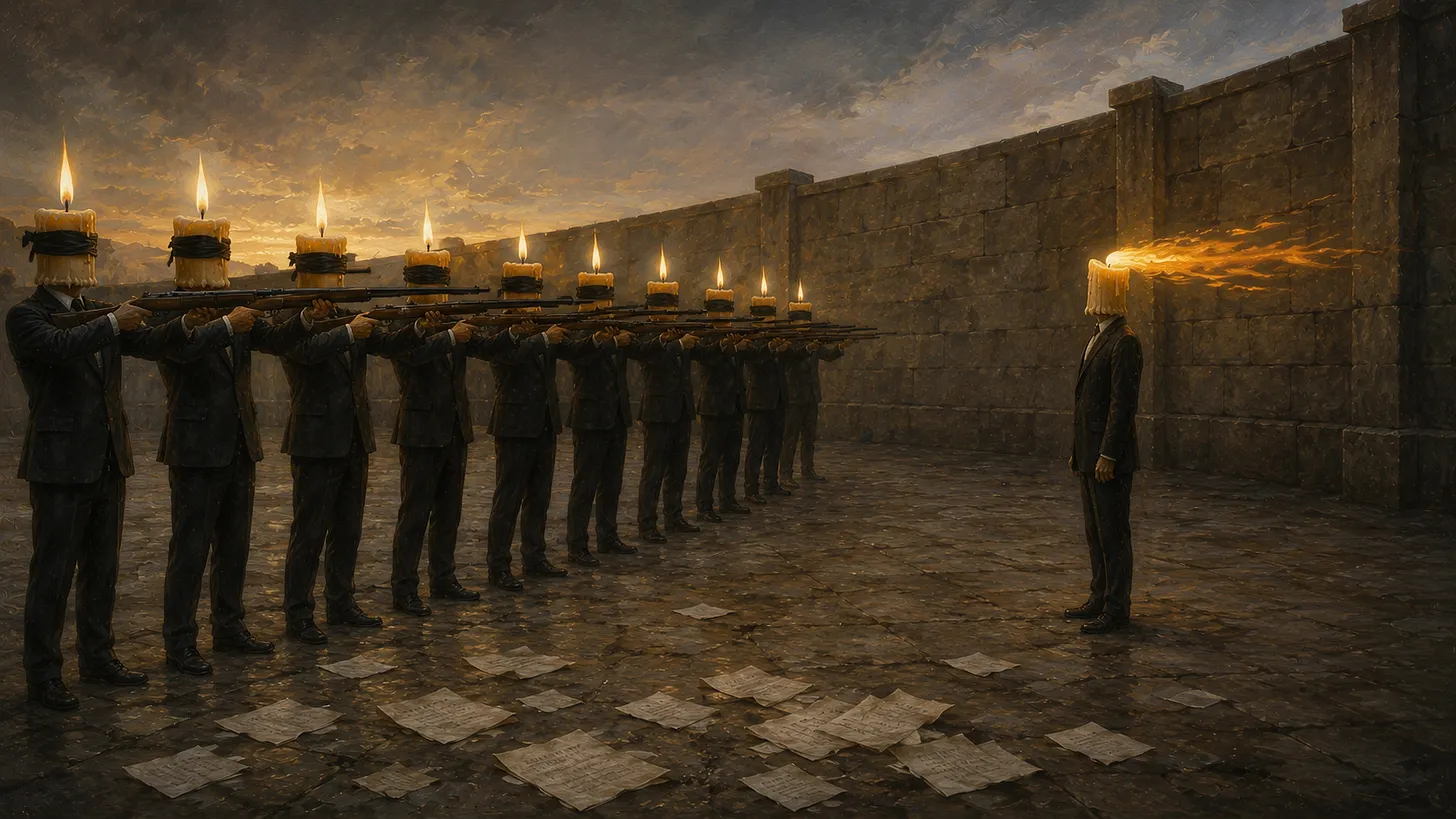
“That is why you wanna shoot the Cassandras.” — Andy Grove, MIT lecture, 1996
In 1996, Andy Grove stood in front of an MIT audience and performed a brilliant public autopsy on his own judgement. Intel had been the pioneer and leader of semiconductor memory. When Japanese manufacturers arrived as an overwhelming force in the mid-eighties, the first signal reached Intel through its sales force in Japan, who reported that customers were treating them with less respect. Grove’s account of management’s response is honest, he thought he was dealing with a whining sales force, not an inflection point. He admitted, “Our sales force told us. Us being management, we ignored it.”
While those at the top of the company theorised their top-down strategy, the people closest to the action executed what they knew to be best for the company. Intel’s production planners began shifting factory resources (cellular energy if you will) away from memories and toward microprocessors without fanfare and without asking, simply because microprocessors made more money.
By the time senior management realised that the memory business was dying, these unauthorised reallocations had already redirected the company. Factories still had to close, but far fewer than if the planners had waited for permission. Grove named the gap that had opened between what the company said it was and what its own people were doing, “strategic dissonance”. The organisation’s stated identity was a memory company. Its actual resource flows, redirected by those in the trenches, said and did otherwise.
What makes the lecture so authentic is how Grove never presented himself as any kind of hero. He shared why leaders attack the bearers of early signals. It is quite simply that the denial of a new thing you do not want to deal with, and do not know how to deal with, is so strong “that is why you wanna shoot the Cassandras.”
The teacher of strategic inflection points is describing his own overactive inflammatory response, one many leaders emit. The immune system that saved Intel was not leadership. It was the autonomous action of cells the hierarchy had not yet listened to, moving resources toward the future while the organisation’s official mind argued with the diagnosis.
Acquired Tolerance: Rejection is the Default, but it is not Destiny.

In 1960, Peter Medawar shared the Nobel Prize with Frank Macfarlane Burnet for the discovery of acquired immunological tolerance. That is how a body exposed to foreign cells early enough does not learn to fight them, but to accept them, permanently. An embryo has not yet learnt to detect what is native from what is foreign, and cells introduced at that stage are filed as self for life. Rejection is the default, but it is not destiny. Tolerance can be induced. It simply has to be built in early and maintained for life.
We run this protocol in our own house. My younger son has a nut allergy, and to build his tolerance we follow a nut exposure programme: small, deliberate, daily doses of the very thing his immune system would otherwise attack, increased gradually over time. His system is slowly learning to file the threat as food. Organisations acquire tolerance the same way, through regular, deliberate exposure to the strange, in doses, not in announcements.
An organisation cannot wait until Salem City to discover a taste for heresy, because by then the inflammatory response has become the culture. Tolerance for the strange, for the autonomous initiative, for the Cassandra with unwelcome news, has to be grafted in while the organisation is young. And then it must be deliberately kept alive through continuous exposure.
Greg Satell, a regular guest on the show advises that announcing change grandly presents it as a fait accompli and hardens the antibodies. If, however, you start with small groups of the already-willing, you allow the tissue graft take hold before the immune system mobilises. Adizes reaches the same verdict from a lifecycle perspective, ageing is not an unavoidable fact of organisational life, and a company that keeps its capacity for change integrated can, in principle, renew indefinitely.
The brain study gives all of this a harder edge. The founding cells begin leaving at fifty. The substitution of a reactive population for a creative one is invisible to every dashboard that tracks behaviour, because behaviour is the last thing to change. If you want to know whether your organisation is ageing, do not ask what it is doing. Instead, think about where its people came from, what happened to the ones who carried the founding temperament, and how it responded the last time somebody brought it a strange protein.
The body rejects the graft by default. Medawar’s discovery is that it does not have to. Tolerance is acquired, but must be acquired early, on purpose, or not at all.

This Thursday Thought accompanies part three of our Strategyzer series with Alex Osterwalder on The Innovation Show, where we pick up Osterwalder’s Law, the sales incentives that stalled SonoSite’s iLook, and how leadership teams design governance so exploration survives contact with the core.
Just by being a member of this Substack you are placed in the draw for one of Alex’s books, and Innovation Show listeners get 20% off Strategyzer’s paid playbooks with the code INNOVATIONSHOW20.
Also worth a watch:
Also worth your time