

TL;DR Innovation enters organisations from the edges, not the centre. Chuck House defied his founder, built the screen the world watched the moon landing on, and was demoted twice for being right. Jonas Salk and Jeff DeGraff named the same four stages, decades apart: the idea is dismissed, then resisted, then co-opted, then absorbed. Like a chemical catalyst, the person who loosened the bond is rarely the one who gets credit for what came next. The reaction is the wage. The loosening is the work.
“A man may do an immense deal of good, if he does not care who gets the credit for it.” — Father Strickland, c. 1863
The word catalyst comes from the Greek katalúō, to loosen, or untie.
In a chemical reaction, a catalyst loosens the bond that has been holding the reactants in place. The energy comes from elsewhere, from heat, time, pressure. Most reactions would happen on their own eventually, given enough of each. The catalyst removes the kinetic barrier, and a reaction that would have taken years happens in seconds.
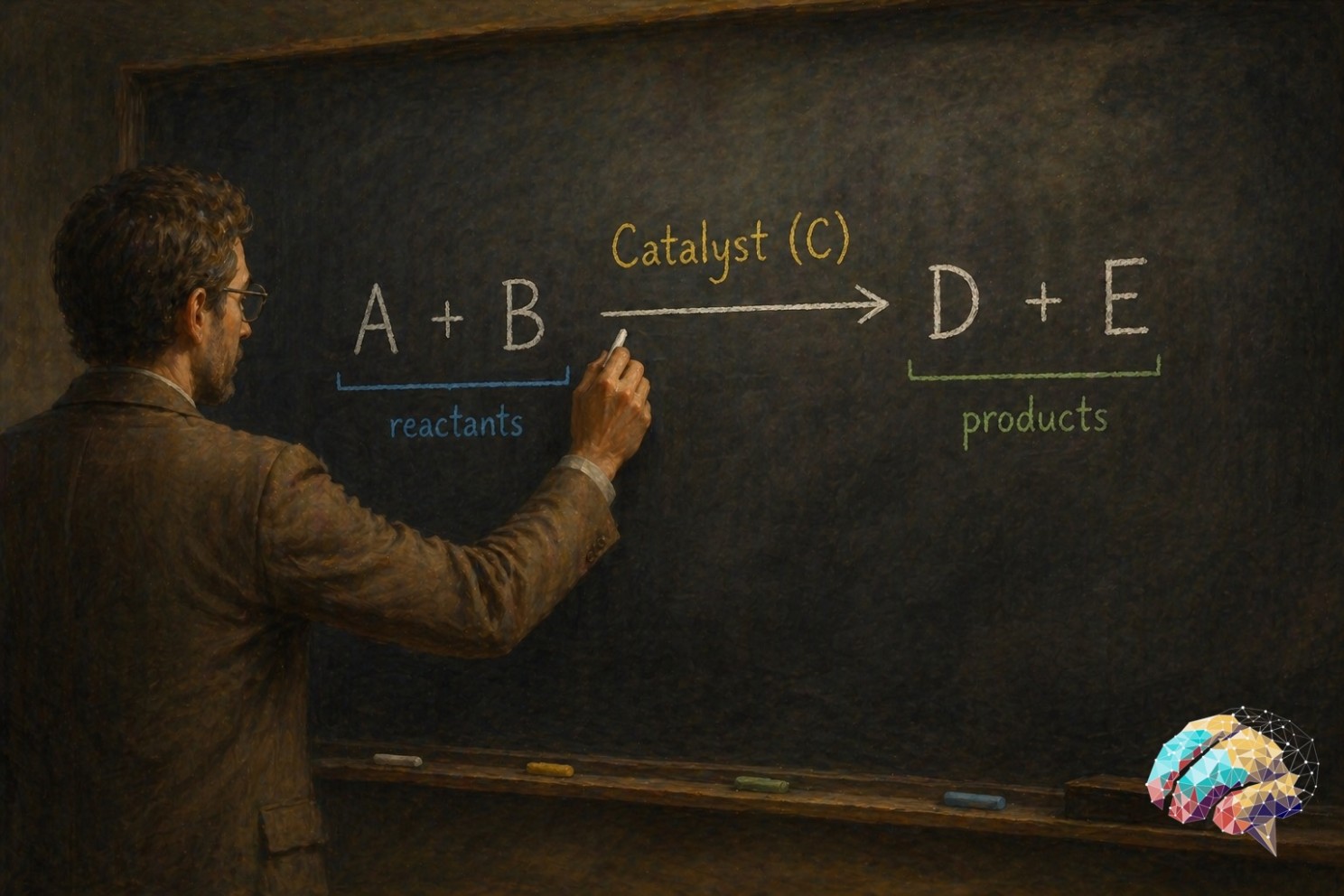
When you write the equation up on a board, the reactants sit on one side and the products on the other. The catalyst sits above the arrow as a condition of the reaction rather than a part of it. When the new compound, the result, is in front of you, the catalyst is gone from view. In some reactions it is recovered intact. In others it is poisoned by the waste it helped to create. Either way, the catalyst is out of sight.
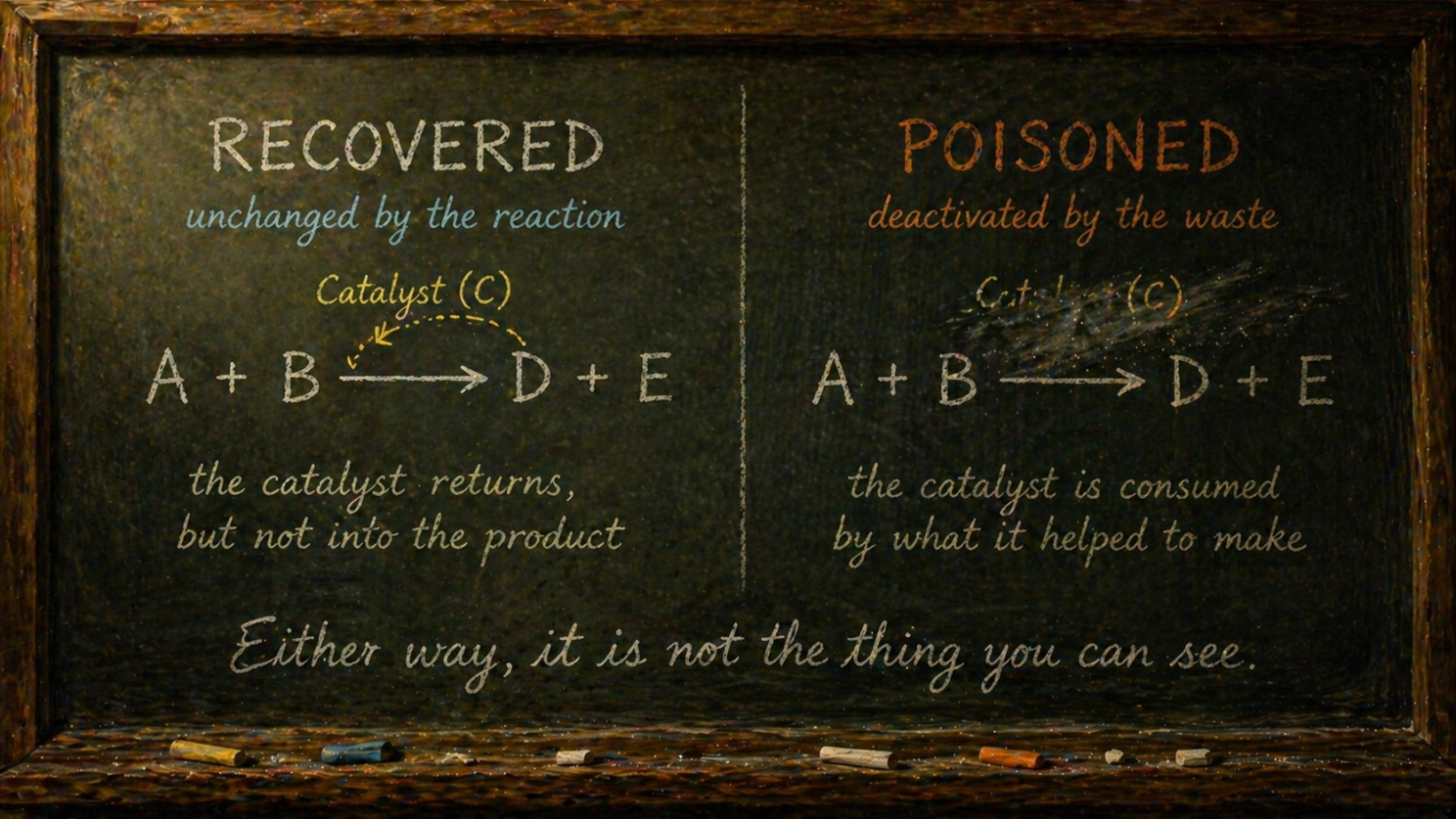
That is also a description of how most innovation enters most organisations. The kinetic barriers in a company are fear, bureaucracy, hierarchy, reward systems, and the gravitational pull of last quarter’s strategy. The catalyst, the changemaker, the intrapreneur, loosens the bonds. The force that loosens them is rarely the one that gets credit for what comes next. Success has many parents.
A Familiar Tale
“I wasn’t worried about my boss. I was worried about the company.” Chuck House
In 1966, HP engineer Chuck House refused to kill a project the HP co-founder David Packard had personally ordered killed. The project was a large-screen display. The internal market study had predicted a worldwide demand of about thirty units. After a division review, Packard told House’s bosses that when he came back next year he did not want to see this project in the lab. When he heard the news, Chuck interpreted the words to suit his ambition. He moved the project out of the lab and into production. When Packard returned a year later, he pounded the table and bellowed “I thought I said to kill this damn thing.” House replied: “No, sir. You said when you came back, you didn’t want to see this in the lab. It isn’t. It’s in production.”
The answer was not well received.
The defied display went on to be used in pioneering heart surgery and as the prototype display for Alan Kay’s first personal computer. It won a Hollywood technical Oscar. And on the 20th of July, 1969, it produced the live television image of Neil Armstrong’s first step on the surface of the moon. Against an internal forecast of 30 units, it shipped nearly 18,000.
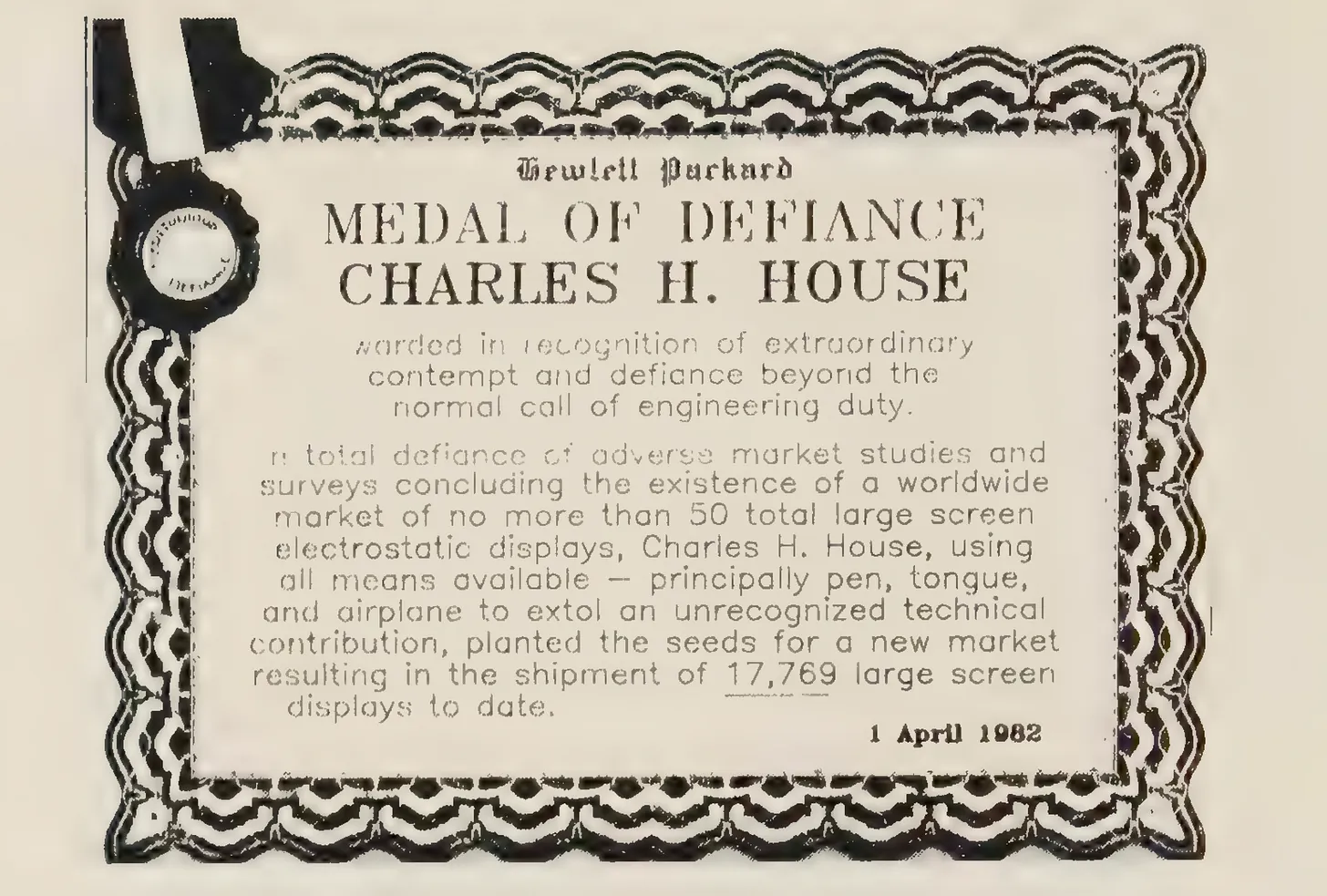
Sixteen years after the row in the lab, in 1982, HP gave him a medal. There has only ever been one. It is called the Medal of Defiance, and the citation reads “awarded in recognition of extraordinary contempt and defiance beyond the normal call of engineering duty.” Chuck thought the plaque was a joke. He set it on a shelf in his new Palo Alto office, and a few weeks later he threw it in the bin. Years afterwards, when David Packard published his autobiography, House read for the first time that the award had been real. Packard had written about him by name, and asked, in effect, what one does with someone who is insubordinate when they are right.
Almost no one watching Armstrong on a 1300A screen knew the screen existed. Fewer still knew that the man who built it had been ordered to stop. The catalytic reaction proceeded. The new compound existed. The catalyst was gone from view.
Two people, the same four stages
After the display was a success, Chuck was invited to give a short talk at an HP lunch with visitors from Bell Labs. At the time, he was reading Thomas Kuhn on paradigm shifts. He stood up and described, off the cuff, the four stages every intrapreneur endures.
“First, your original idea gets ignored. It is too radical.
Second, when the idea grows, it is seen as a threat. Others try to stop it.
Third, as momentum builds, they try to corrupt or debase the idea, to rid it of its truly radical capability.
Fourth, when it succeeds, they are quick to take credit for creating, modifying, or completing the idea.”
The Bell Labs people loved it. Chuck’s bosses (identifiable in every stage of the speech) did not. As they left the event, Chuck’s boss put an arm around him and sarcastically quipped, “You are fantastic with a speech. You could be on television. I think you should be on television. I’m taking you out of your job.” Chuck was off the project that day! He was demoted twice during his time at HP. By his own account, he was relieved each time. Further from the centre, he was closer to the work.
Years later, our guest on this week’s Innovation Show, Jeff DeGraff sat down with the man who had developed the polio vaccine. Jonas Salk told him what to expect from a life spent working in innovation.
“When you start doing something really innovative, no one will notice. After that, they will tell you that you are doing it wrong. After that, they will call you unprofessional. In the end, they will take credit for your work.”
Two men, decades apart, named the same four stages. Dismissal, resistance, co-option, absorption. The convergence is the shape of the experience itself.
The reality of being an innovator.
The Edge of the Circle
“Organizations love innovation but hate their innovators.” - Jeff DeGraff
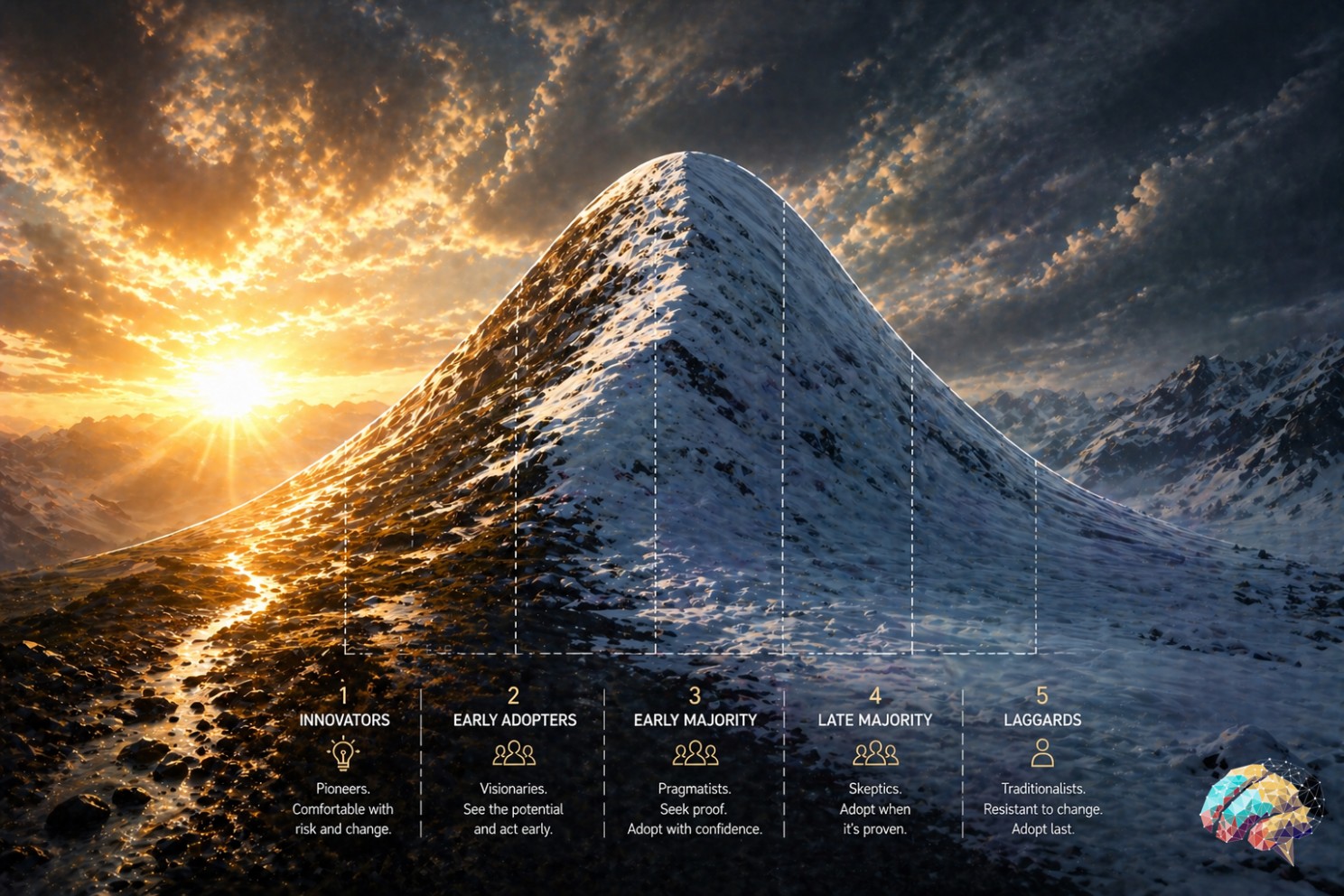
In a recent conversation on the show, Jeff DeGraff put it this way, “Innovators stand at the edge of the circle. They don’t stand in the middle of the circle.” The middle of an organisation, he says, is built to maintain itself. The middle exists to scale, to derisk, to make next quarter resemble last quarter. Radical innovation moves from the outside in. From crisis, from exceptions and from the people who are not quite where the meetings are happening.
Andy Grove had named the same image from inside Intel. He spent decades watching markets shift, including the shift that nearly killed his own company. In Only the Paranoid Survive he wrote, when spring comes, snow melts first at the periphery, because that is where it is most exposed.
Rita McGrath, one of the sharpest contemporary thinkers on strategy, opens Seeing Around Corners with Grove’s snow line and develops it into a working method for spotting inflection points before they arrive. She argues that evidence of an emerging inflection point doesn’t present itself neatly on the conference table in the corporate boardroom. It is the people in direct contact with the phenomenon who notice the changes first. Nokia’s collapse, she has written, came after its leadership had quietly lost touch with the edges.
DeGraff’s edges, Grove’s edges and McGrath’s edges are the same edges. They are the parts of an organisation in direct contact with whatever is changing in the world outside it. The customer who is unhappy in a way nobody at headquarters has heard before. The supplier quietly building the thing that will replace your supplier. The junior person on a team who has noticed that the assumption everyone is working from has stopped being true. None of them are at the centre. They are exposed. That is also why, as Grove wrote elsewhere in the same book, the people in the trenches are usually in touch with impending changes early.
If you have ever been in the trenches, you have already lived the conversation where the observation you offered was dismissed, then six months later was presented back to you in a meeting by someone who did not recall hearing it from you. Being right early and being heard early are two separate skills.
The Barley or The Wage

“A society grows great when old men plant trees in whose shade they shall never sit.” - Greek proverb
The hardest part of catalytic work is the absorption of what you built into something that no longer carries your name. The thing you fought for ends up on a stage with someone else there, and the person at the lectern may genuinely have forgotten that the idea did not start with them. Chuck House saw it. Jonas Salk saw it. Jeff DeGraff has seen it across half the Fortune 500.
The reason it keeps happening is that organisations exist to absorb.
In Requiem for the Croppies, Seamus Heaney writes about the Irish rebels of 1798 who carried barley grain in their pockets. When they were killed, they were buried in a mass grave, without shroud or coffin.
This morning I delivered a workshop with the team from Thompson Harrison )with Gavin Weeks and Samantha Rockey) for the Law Society of Ireland. Dr Niall Connors opened the day by reciting Heaney's poem, which ends in a beautiful line.
“In August the barley grew up out of our grave.”
The barley grew because the grain in the pockets of the dead found its bed in the compost of their bodies. The seed and the soil were both theirs. They were not separated from what followed. They became the very foundation of it.
Most of what we walk through today rests on bodies we do not see and names we do not know. Freedoms, medicines, rights, institutions, the machinery of any decent society. People stood “at the edge” with the grain in their pockets.
Likewise, the catalyst sits above the arrow, never inside the equation. In some reactions it is recovered intact. In others it is consumed by the waste it helped to create. Either way, the new thing is made possible by it, and it is not the thing you can see. That is the geometry of how change actually moves.
The reaction is the win.
The loosening is the work.
The credit is the price.
The barley is the wage.
On this week’s Innovation Show
This Thursday Thought is part of a current trilogy on the show with Jeff and Staney DeGraff, professors and authors who have spent their careers helping organisations turn deviance into growth. We have already covered The Innovation Code, where Jeff and Staney lay out the four worldviews that drive innovation, and The Creative Mindset, on neoteny and beginner’s mind. This week we close the trilogy with their newest book, The Art of Change, which opens with the story of a colonel called Luis whose process became the spine of Operation Warp Speed and who was passed over for promotion when it worked. If anything in this Thursday Thought rang a bell, the conversation will land harder.
Coming up after that, a three-part series with Bruce Vojak, co-author of Serial Innovators, on the people inside large organisations who keep doing this work anyway.
The Winners of The Creative Mindset are Justin C and Andrew McA. I will get the books to you gents.
Episode links
Jeff DeGraff and Staney DeGraff on The Innovation Code, The Creative Mindset, The Art of Change
Rita McGrath series:
Chuck House on Permission Denied (Parts 1 to 4): the Medal of Defiance, the four stages, and the work of an intrapreneur over thirty years at HP
Coming Next:
Bruce Vojak on Serial Innovators (forthcoming, three parts)