
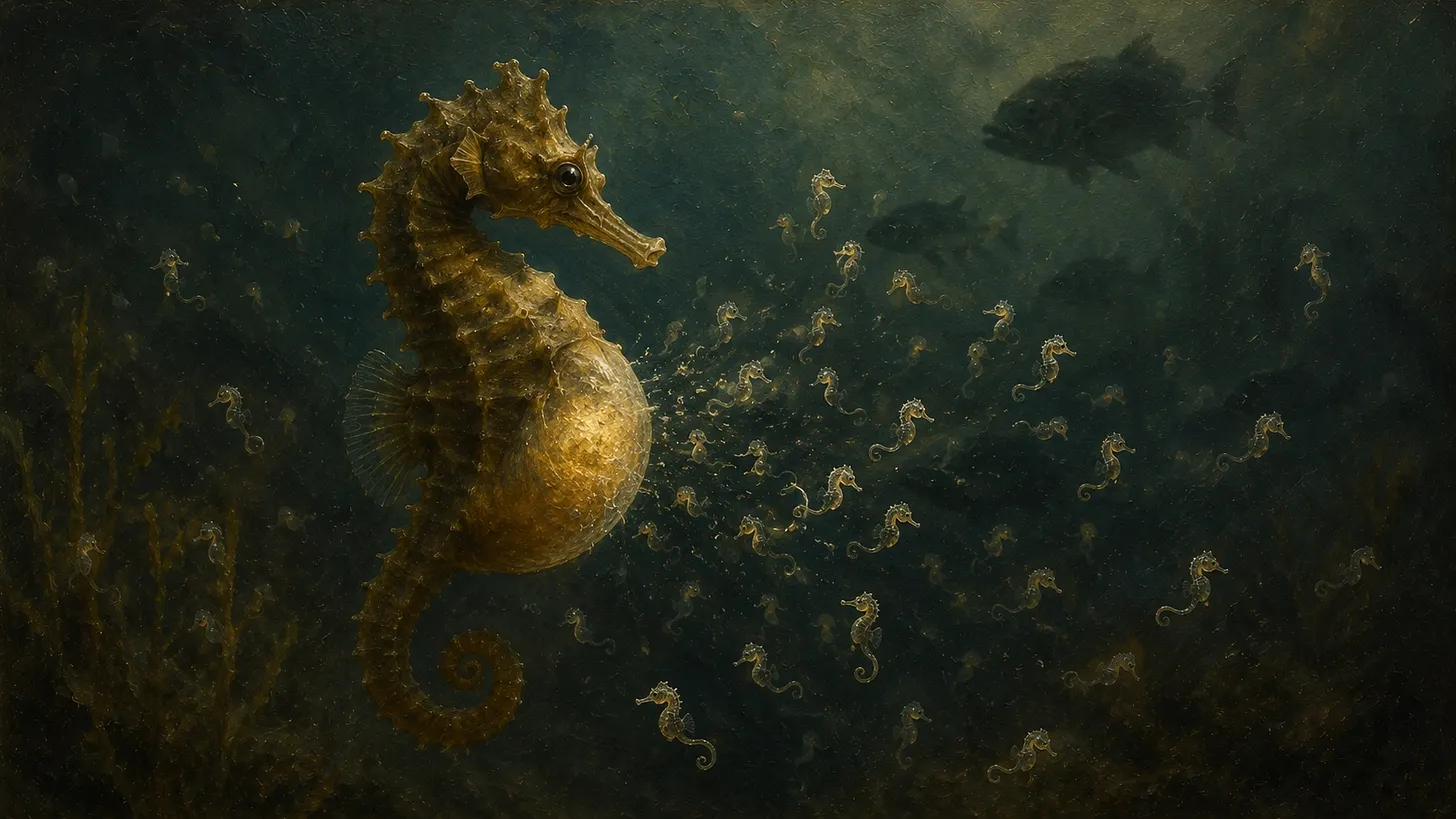
TL;DR: A male seahorse carries thousands of young and then releases them into an ocean that will kill most of them. In water that hostile, the strategy is abundance coupled with the acceptance that most will be lost while a few can carry the species forward. Organisations and careers now live in a similar waters. The advantage that lasts is a portfolio of small bets we must keep running and a willingness to reinvent before we are forced to.
"What matters in options is the cost of failing, not the rate of failing."- Rita McGrath
A Labour of Love
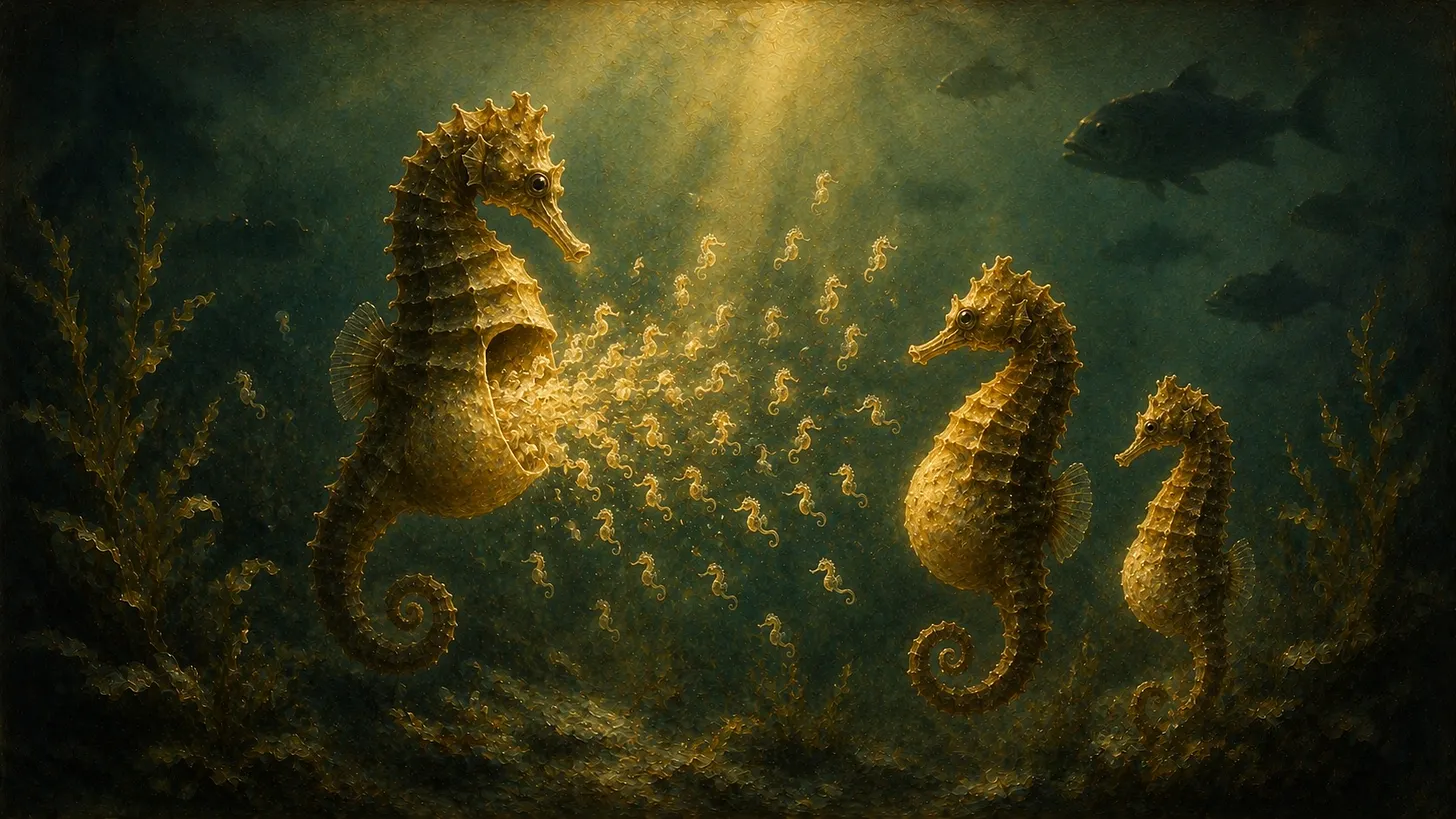
A male seahorse becomes pregnant. The female deposits her eggs into a brood pouch on his belly. He fertilises the eggs for ten days to six weeks. Then he goes into labour. The pouch contracts in long rhythmic pumps, sometimes for hours, until thousands of fry no bigger than eight to ten millimetres are expelled into open water, translucent and barely formed.
Once out of the pouch he can no longer protect them. Currents pull the fry away from the cover of seagrass, away from food. Predators work the shallows where they drift. For those who survive the predator, starvation takes most of them. Fewer than one in two hundred reach adulthood.
That survival rate sounds catastrophic, but for fish it is remarkably good. The pouch is the difference. By carrying the young through their most fragile days before release, the male buys them a head start that most fish don’t get. Even still, he must release them into the chaos anyway.
This is what survival looks like in an environment that doesn’t reward caution. The seahorse does not place just one careful bet and defend it. They make many, they accept that almost all will be lost, and they trust that a handful will find the conditions to sustain the species.
Strategy is no different.
The Moat Is Already Eroding

"The new system looks nothing like the old system." - Sangeet Paul Choudary
The old idea of strategy was to find a defensible position and build a moat around it. You built an advantage, raised the walls and defended those walls for as long as possible. Rita McGrath alls it a transient competitive advantage. An edge that once lasted decades now lasts years or months. Once you have optimised something, the ground beneath it has already moved.
Her answer is the seahorse strategy in the language of business. She advises we run a portfolio, we protect and improve the core we already exploit, we fund the platforms we believe will become the next core, and seed many small, cheap options around the edges, knowing most of them will die.
Rita sorts such options into positioning, scouting and stepping-stone bets, each one a small investment that buys the right but not the obligation to invest more later. The discipline that makes it work is a reversal of common business instinct. What matters in options, she says, is “the cost of failing, not the rate of failing.”
We must make each attempt cheap enough that it can be written off for the greater good. A seahorse who could afford only one offspring would never risk the open water.
Reinvention Is the Product

In The Invincible Company, Alexander Osterwalder writes that the business “explores the future, while excelling at exploiting the present”, running the engine that pays the bills with one hand while building the engine that will replace it with the other. The two portfolios obey completely different logic, and the work of leadership is to hold both at once rather than letting the profitable present starve the unproven future.
Amazon did this when it turned its own internal infrastructure into Amazon Web Services. Thus, it set up a business with new economics alongside the retail operation that had built it. The size of the bet is not the point. The point is that the company treated reinvention as something it produces continuously, not something it survives just once.
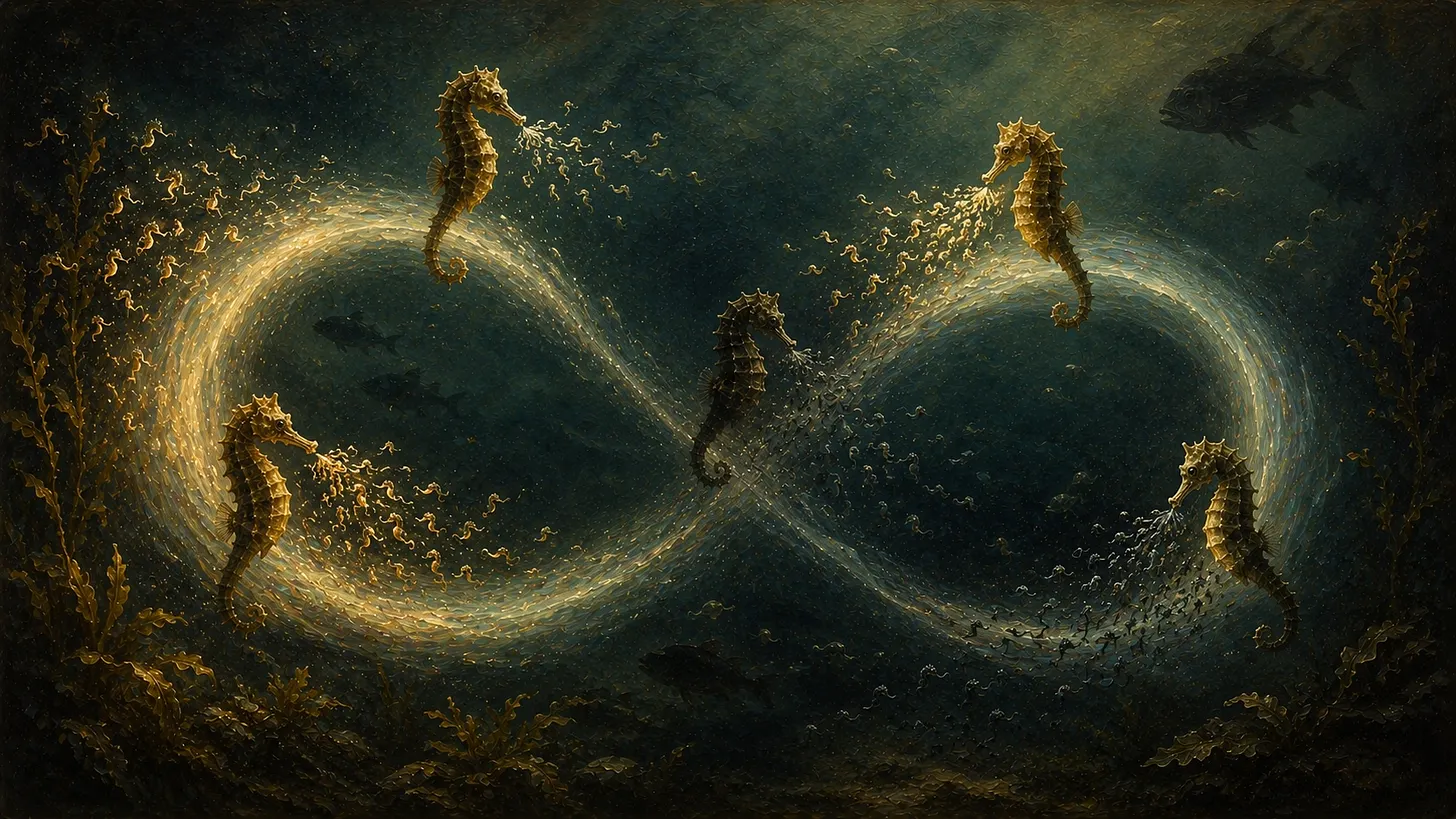
That continuity is the part the business playbooks tend to miss. We talk about jumping from one curve to the next as though there were a far bank to reach, a single leap after which you are safe. There is no far bank. The curve you are riding is already bending back on itself, an infinity curve rather than a staircase, rising and falling and rising again, and the moment you reach the top of one the descent is already underway.
Reinvention is not an event you schedule, but the shape of the whole journey.
Adobe Did Everything Right, Except One Thing

“When is the last time evolution called and asked were you ready?” - Dee Hock, VISA CEO Emeritus
The clearest proof that reinventing once is not enough is a company that reinvented brilliantly and was caught anyway. For years many of us held Adobe as the example to follow. In 2013 it walked away from boxed software and moved its entire business to the cloud and a subscription model, rewiring its sales force, its product cadence and its relationship with Wall Street to do it. It managed the transition that broke other companies. As Sangeet Paul Choudary put it on The Innovation Show, Adobe “did everything right” that a company is supposed to do in the face of a technological shift.
Then Figma arrived and made that hard-won advantage transient mid-stride. The familiar explanations, that incumbents are slow and start-ups are fast, Choudary dismisses as both true and useless. The real difference was structural.
Adobe was built around the logic of the design file, with everything organised to produce one high-fidelity file and hand it on to a collaborator. Figma, born after the cloud, was built around the logic of the individual element inside the file. The single button or component that could be governed and reused across an entire organisation. That architectural strategy is what turned design from a solo handoff into a shared, governed workflow. It is precisely what Adobe could not copy without becoming a different company.
Howard Yu, who has studied long-lived outliers for years, reduces the entire lesson to three words: stay “one inch ahead”. An inch of lead time, not a crystal ball. Adobe had reinvented once, may have believed it had a moat, and stepped off the curve while the curve kept moving.
What Keeps a Body Reinventing
Reed Hastings subtitled his book on Netflix “the culture of reinvention”, and the culture he describes runs on candour, on the freedom to act without first asking permission, and on people who can give and receive honest feedback without it landing as failure. Those are human capacities before they are corporate mechanics. They are the same ones that let a person keep reinventing through a working life that no longer offers a single stable career.
The skills that carry us through constant change are mostly not the ones we were graded on at school. They are the capacity to stay curious when the ground shifts rather than gripping harder to what used to work. To hold a real conversation with someone who sees the world differently and come out of it changed rather than entrenched. To treat feedback as information rather than injury whether we are giving it or receiving it. A person who can do those things keeps seeding new attempts, is resilient when most of them fail, and learns quickly enough from the survivors to begin again.
The male seahorse cannot guarantee a single one of his thousands of young. He can only keep producing them. He can give them their brief protected runway, and continue trusting the few that survive to find conditions to grow.
The one thing he knows is that the water is not getting calmer.
This week on The Innovation Show, Geoffrey Cain on Steve Jobs in Exile, the untold story of the dozen years between Jobs being forced out of Apple and his triumphant return. By the early 1990s he was three years from running out of cash, abandoned by investors, his products failing one after another, and close to being written out of history. Drawing on unbroadcast footage and oral histories, Cain tells the unvarnished version: the wilderness years at NeXT that remade him as a leader, and why there would be no Apple as we know it without them.
Watch:
Rita McGrath: The Entrepreneurial Mindset
A competitive edge used to last decades. Now it lasts months.
Rita McGrath on The Entrepreneurial Mindset: how to run your business as a portfolio of bets, why most of them are meant to fail, and the line that reframes the whole thing, that what matters is the cost of failing, not the rate of failing.
Watch:
Alexander Osterwalder: The Invincible Company
No company is invincible. The ones that come closest reinvent themselves before they are forced to.
Alexander Osterwalder on The Invincible Company: running two portfolios at once, exploiting today’s business while exploring tomorrow’s, and the tools to keep reinventing on purpose rather than in a crisis.
Listen:
Howard Yu and Sangeet Paul Choudary: Adobe vs Figma
Adobe did everything right. It moved its whole business to the cloud and managed the transition that broke other companies. Then Figma arrived and made that hard-won advantage transient mid-stride.
Howard Yu, author of Leap, and Sangeet Paul Choudary, author of Reshuffle, take the case apart: the three acts of every business, the architecture that let Figma win, and why you only need to stay one inch ahead.
Watch: